Starting point
There were enough inquiries, around 800 a month, almost 40 on a normal working day. The trouble was that they came from everywhere: through the form on the website, by email, as referrals, via LinkedIn and from personal conversations. It was often unclear what was really new, what had already been answered and who should get in touch next.
None of this was meant to become an aggressive sales machine. The team wanted to spot good conversations sooner and follow up reliably, without forcing every inquiry straight into an overloaded CRM.
Every inquiry stayed where it arrived
A LinkedIn chat stayed on LinkedIn. A referral sat in the inbox. A website form got forwarded. That worked fine as long as a few people kept everything in their heads.
So before anyone could reply, there was the search. Is this person already a contact? Has someone already replied, and who is responsible? That meant going through the inbox, LinkedIn messages and notes, around 8 minutes per inquiry. Across 800 inquiries, that was more than 100 hours a month. At €45.00, what an hour of work cost on average in Germany in 2025 (according to Germany’s Federal Statistical Office), the search alone cost around €4,800 a month.
One in 5 inquiries fell through the cracks
Because nobody was clearly responsible, everyone relied on someone else to reply. The first reply often came only after 2 days. Around 160 inquiries a month, one in 5, got no second message after the first. Some contacts were written to twice, others not at all.
A study published in the Harvard Business Review in 2011 shows how expensive a long wait is. Across 2,241 US companies, the first reply to a test inquiry took 42 hours on average, and 23 percent never replied. A second analysis of 1.25 million inquiries at 42 companies found that a contact attempt within one hour led to a conversation with the decision maker nearly 7 times as often as an attempt one hour later, and more than 60 times as often as one after 24 hours or more.
Implementation
Lead routing with one list for 5 channels
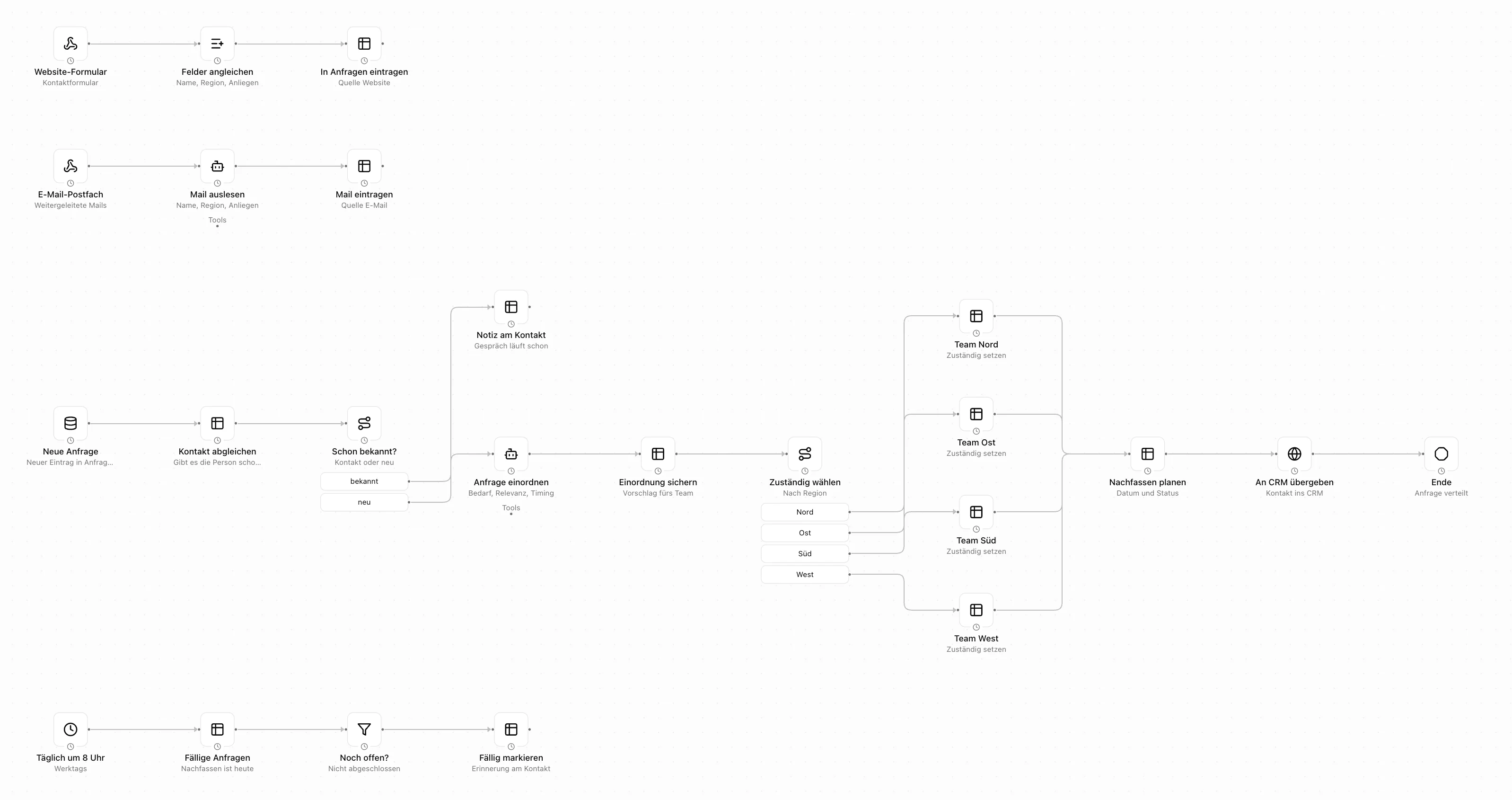
In Pharen Hub we set up one list for all inquiries, plus a workflow that fills it and distributes them. The workflow enters inquiries from the website form by itself. An agent reads forwarded emails and picks up name, region and request. The team enters referrals, LinkedIn messages and conversations by hand into the same list, and that starts the process too.
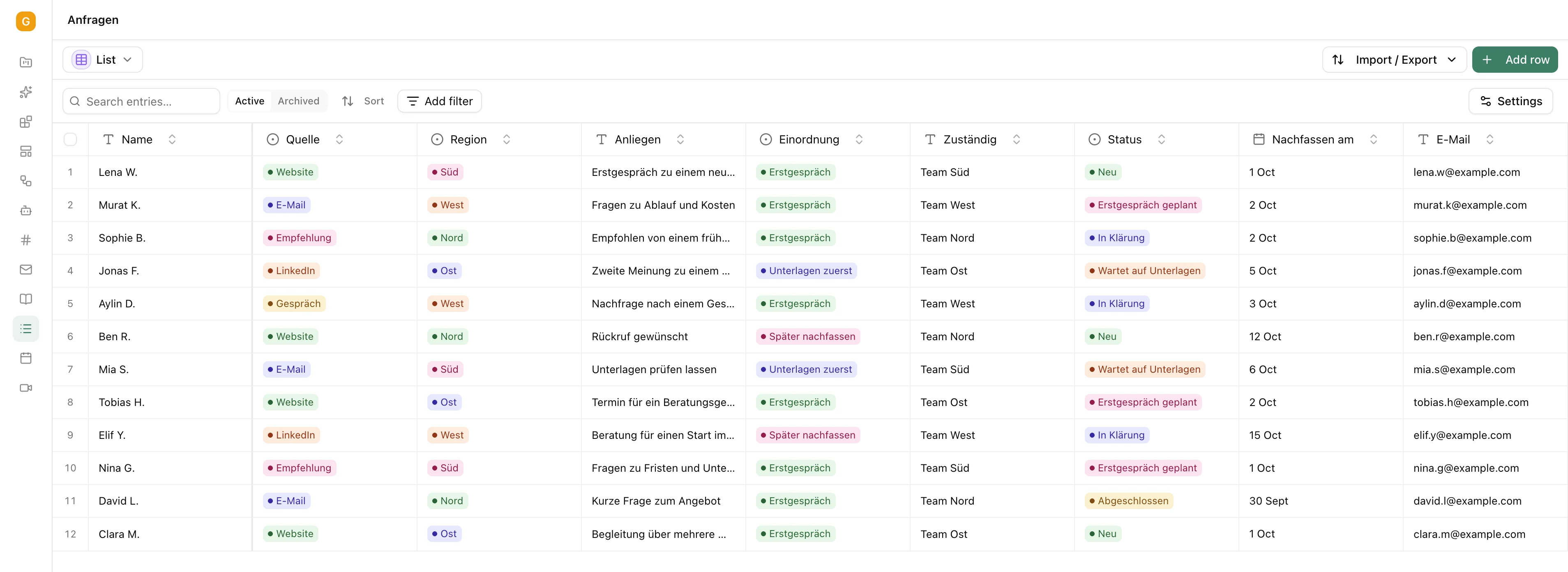
At the start, no contact has to be scored yet. Every inquiry first needs a source, a short assessment, a team and a next step.
An inquiry goes through 5 steps
- Match the contact. The workflow checks whether the person already exists. If a conversation is already running, the inquiry goes to the existing contact as a note, and nobody writes to the person a second time.
- Sort the inquiry. For new contacts, an agent suggests a category based on need, relevance and timing: first meeting, documents first, or follow up later.
- Choose the team. A rule assigns the inquiry by region to Team North, East, South or West.
- Plan the follow-up. The inquiry gets a status and a date on which the team gets back in touch.
- Hand over to the CRM. The contact goes into the CRM, and the inquiry is assigned.
Every working day at 8 a.m., the Hub looks for inquiries whose date has come and that are not yet closed, and sets a reminder on the contact.
A category alone would have changed nothing. Inquiries fell through the cracks because nobody was responsible. That is why the AI process automation connects the agent’s suggestion with a rule for the team and a date.
People hold the conversation
The workflow sends nobody a message and turns nobody down. The category is a suggestion that the responsible person can correct. The process is there to help the team coordinate, and it does not rate anyone by criteria they cannot see. Our German post on lead management with AI explains why a short inquiry is no basis for judging the customer.
Result
Over 90 hours less searching a month
Whether the contact already exists, who is responsible and when to follow up is now in the list before anyone opens the inquiry. Per inquiry, around 1 minute remains for a look at category and team, where it used to be around 8. More than 100 hours a month have become around 13.
That saves the team over 90 hours a month, more than 2 working weeks. At €45.00 per working hour, that is around €4,200 a month.
First reply on the same day
The first reply now usually goes out the same day. Before, it often took 2 days. The roughly 160 inquiries a month that used to fall through the cracks now have a team and a date. Once the date comes, the Hub keeps reminding the team until the inquiry is closed.
If one in 6 of these 160 inquiries books, that would be around 27 additional engagements a month. This does not promise any particular conversion rate. Whether a conversation turns into an engagement depends on the offer, the timing and the conversation itself. What can be measured is what the process influences: the time to the first reply, inquiries without a team and overdue follow-up dates.
Inquiries still come from everywhere
Website, inbox, referrals, LinkedIn and conversations all stay. Now they all land in one place, with team, status and date.
Every inquiry now finds its team, and the team can find every inquiry again. 📬
Published on , updated on .