An AI strategy for business is a two page decision: which three workflows you tackle first with AI, which data may go into which tools, who is responsible, and which number tells you after 90 days whether it is paying off. For a small or mid-sized company it takes half a day of workshop plus some preparation and write-up, and with us the workshop starts at €399 plus VAT.
This article is for managing directors of companies with 10 to 250 employees where a few people already use ChatGPT or Copilot every day but nobody has agreed a plan. It covers the seven building blocks a strategy needs, gives you a template to fill in, works through three example workflows to show where to start, and lists the mistakes that usually sink these documents.
Nobody needs a 40 page paper for this. A year from now you will want to look up why the company decided what it did, and for that you need the numbers, the names and the rules. They fit on two pages.
What is an AI strategy?
An AI strategy is the written decision about what your company will use AI for over the next twelve months, and what it will leave alone. It links a business goal (quote faster, approve invoices on time, handle more enquiries with the same team) to specific workflows, data, tools, rules and a budget.
It often gets mixed up with three other documents:
| Document | Answers | Length | Who decides |
|---|---|---|---|
| AI strategy | What do we use AI for, in what order, with what budget? | two pages | management |
| Digitalisation strategy | Which workflows run digitally, which systems do we need? | often longer, several years | management and IT |
| AI policy | Which tools and data are allowed, who checks the output? | one to three pages | management, data protection |
| Roll-out plan | In which steps do we rebuild the first workflow? | schedule per workflow | project lead |
The digitalisation strategy comes first, because AI needs digital workflows and data it can work with. The AI policy is one building block of the strategy, and the roll-out plan follows from it.
What goes into an AI strategy for business?
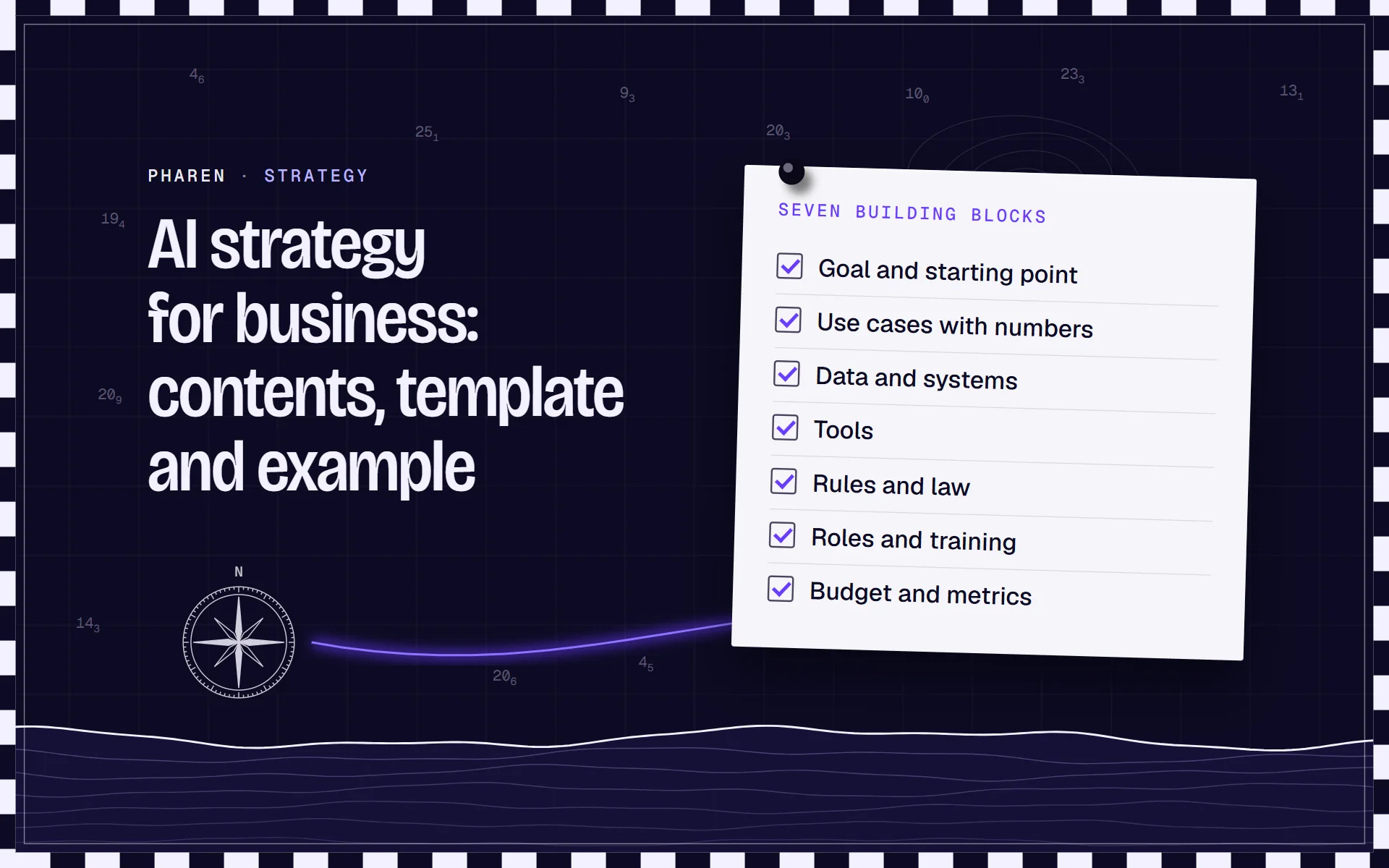
Seven building blocks are enough. Each one answers a question that would otherwise come up during the first project, usually at the worst possible moment.
1. Goal and starting point
One sentence on the business goal and an honest inventory: who already uses which AI tools today, with which accounts, for which tasks? In many companies the list is longer than expected, because staff use private accounts for company work. Write that down before anyone buys new licences.
2. Use cases with numbers
The core of the strategy is a short list of workflows, ranked by what they cost today. Each one gets three numbers: how often it happens per month, how many minutes each case takes and which hourly rate you use. Pick the workflows that run every week, take minutes each time and start with messy input such as PDFs, emails or notes.
3. Data and systems
For each of the first three workflows: where does the input come from (inbox, ERP, accounting software, a folder on the server), where do the results go, and is any personal data involved? This is often where it turns out that AI is not the bottleneck. In a Bitkom survey published in September 2026 of German companies with 20 or more employees, those already using AI named infrastructure and computing power (51 per cent), preparing data (50 per cent) and integration with existing systems (41 per cent) as their biggest cost items. Only 21 per cent named subscriptions and licences.
4. Tools
Which tools do you use for which kind of task? Three levels are typical: a chat assistant for everyday writing and research, an automation tool for fixed workflows, and, where the numbers work, a dedicated AI agent for one specific process. Licences you already pay for (Microsoft 365 with Copilot, for example) belong in this calculation.
5. Rules and law
This block says which data may go into which tools, who checks results before they leave the company, and how you deal with the GDPR and the EU AI Act. Since 2 February 2025, Article 4 of the AI Act has required companies to take care of their staff’s AI literacy. According to Bitkom, 37 per cent of companies see themselves as affected by the AI Act as users, and another 34 per cent are still checking. One paragraph in the strategy that points to your AI policy is enough.
6. Roles and training
Three names belong in the strategy: who owns it (usually management), who makes the decisions for each workflow, and who looks after data and systems. Add one sentence on how the team will be trained. The Bitkom survey shows why: 42 per cent of companies using AI name a lack of acceptance among staff as an obstacle, and 66 per cent rate their workforce’s AI skills as low. We run AI literacy training under Article 4 as a half day workshop with a certificate of attendance.
7. Budget and metrics
A budget for twelve months, split into one-off costs (analysis, build, training) and running costs (licences, model usage, support). For each workflow add one metric you can already measure today: minutes per case, days until approval, share of enquiries answered the same day. Without a baseline there is nothing to compare after 90 days.
Template: an AI strategy on two pages
Copy this outline into an empty document. Each point has a guiding question and a limit on how long the answer should be.
- Goal: What should be different in twelve months, expressed as a number? (one sentence)
- Starting point: Who uses which AI tools today, with which account? (list)
- Workflows: Which three workflows come first, with volume, minutes and hourly rate? (table with three rows)
- Data: Which data flows into which system for each workflow, and is personal data involved? (two sentences per workflow)
- Tools: What do we use for everyday tasks, for fixed workflows, for our own agents? (three lines)
- Rules: Where is our AI policy, and who approves results? (reference and one sentence)
- Roles: Who owns the strategy, each workflow, and data and systems? (three names)
- Training: Who is trained, how, and by when? (one sentence)
- Budget: What does the year cost, one-off and running? (two figures)
- Metrics and review date: How do we measure each workflow, and when do we look again? (one number per workflow, one date)
An empty line is a result in itself. If point 3 has no minutes, you need to map the process first. If point 7 has no name, nobody is carrying the project.
How do you build the strategy in four weeks?
A company with up to 250 employees does not need months of consulting for this. A realistic sequence looks like this:
- Week 1, collect workflows: half a day with management and the people who do the work. Every workflow where AI might help goes on a list.
- Week 2, put numbers on the top three: for the candidates at the top, measure volume and minutes for a few days instead of guessing.
- Week 3, fix data flows and rules: which data may go where, which tools are allowed and who approves. If there is no AI policy yet, it gets written now.
- Week 4, decide and write it down: management picks the first workflow for a pilot, sets budget and metric and fills in the template.
Then work on the first workflow begins. Review the strategy after 90 days and update it with real figures from the pilot.
Worked example: which workflow comes first?
Take a company with 40 employees and three candidates on its list. The calculation uses €45.00, the average cost of one working hour in Germany in 2025 according to the Federal Statistical Office (Destatis). Volumes and minutes are assumptions for this example.
| Workflow | Effort per month today | Value at €45 per hour | 80 per cent of it saved |
|---|---|---|---|
| Incoming invoices: 160 × 5 minutes | 13.3 hours | €600 | €480 |
| Writing quotes: 40 × 30 minutes | 20 hours | €900 | €720 |
| Sorting enquiries: 300 × 3 minutes | 15 hours | €675 | €540 |
The 80 per cent is a cautious assumption, since some time stays with checking and approval. Set that against the costs, for example a first AI agent from €1,999 one-off and support from €199 a month with us (both plus VAT), and the build would pay for itself after just under four months for quotes, about six for enquiries and just over seven for invoices.
On working time alone, quotes would come first. The calculation has two catches, and both belong in the strategy. Quotes need price lists, measurements and standard text, so the build may cost more than the entry price. With incoming invoices, faster approval brings in money on top of the time saved. Hobeck, a roofing company in Belgern, Saxony, receives about 160 invoices a month and saves about 12 hours a month with an automated invoice process. The working time, worth about €475, is the smaller part. Because invoices are now usually approved in 1 to 2 days instead of often more than 7, Hobeck gains about €1,000 a month in early payment discounts. The full story is in our article on automating incoming invoices.
So minutes alone do not decide the order. For each workflow, also ask what faster handling brings: discounts, invoices paid sooner, an enquiry answered the same day.
What does an AI strategy cost, and is there funding?
The strategy itself is the smallest item. A workshop to find AI potential takes half a day and starts at €399 plus VAT with us. If figures are missing, a process mapping for a single workflow with a cost calculation comes on top. The real money goes into implementation, which is exactly why the budget belongs in the strategy.
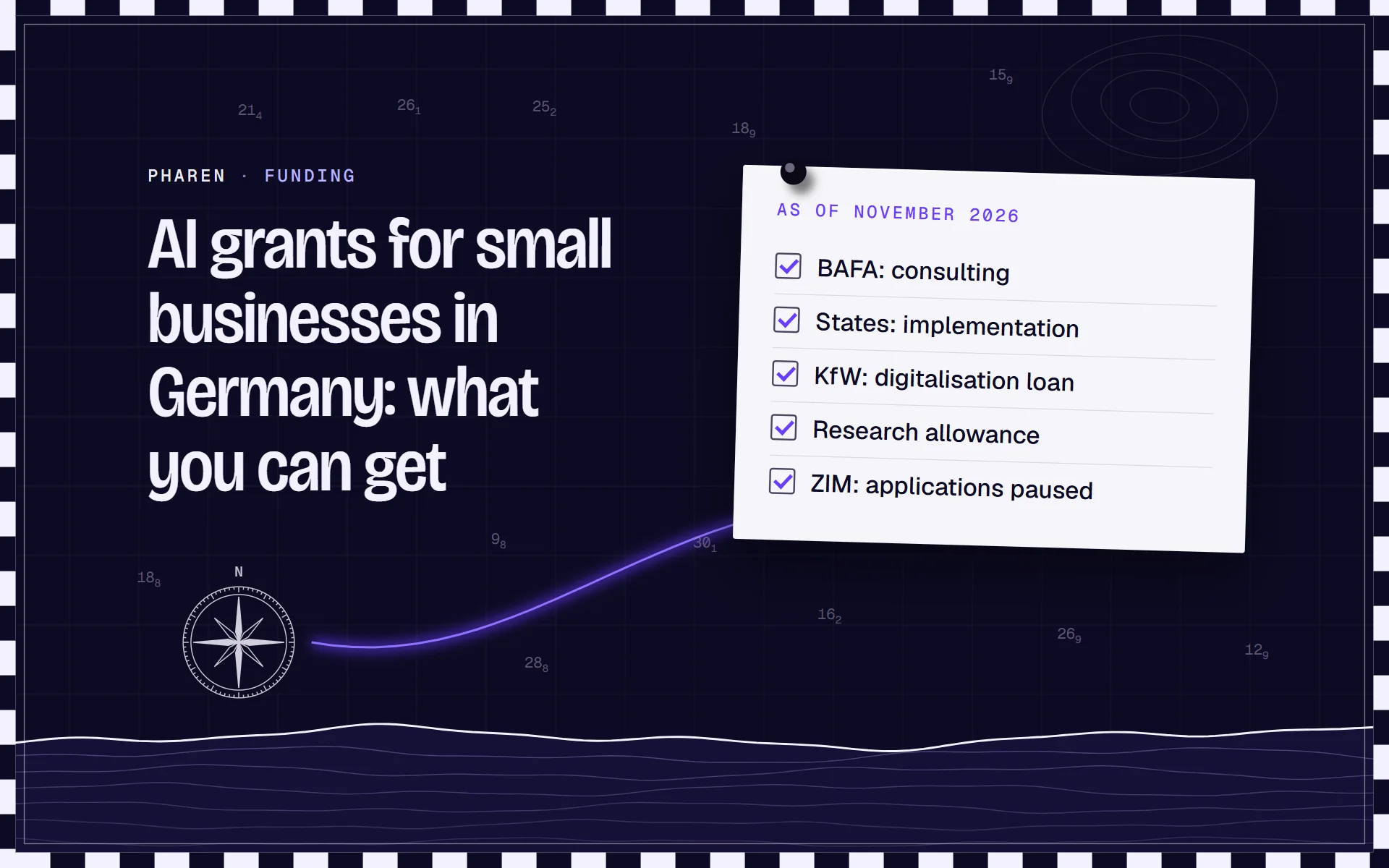
German companies can get grants for consulting. The Federal Office for Economic Affairs and Export Control (BAFA) subsidises individual consulting by registered consultants. According to the Heilbronn-Franken Chamber of Commerce (IHK), the programme has been extended to 31 December 2028, the quota stays at up to two consultations a year and five in total, and from 2027 applications go online via ELSTER or BundID, the German tax and citizen login services. Workshops are not covered. In the city of Leipzig, the district of Leipzig and North Saxony, the Saxon development bank (Sächsische Aufbaubank, SAB) pays a digitalisation grant from €5,000 of eligible costs, though not for consulting alone (as of November 2026). You always apply before the work starts.
Common mistakes, and when you do not need a strategy
When an AI strategy fails, it is usually down to its form. These mistakes come up most often:
- The tool comes before the workflow. Licences get bought for everyone, and then people look for a use. The strategy reverses that order.
- The paper is too long. A document nobody opens after three months helps no one. Two pages on the desk do.
- There are no numbers. “Become more efficient” is not a goal. Without minutes per case today, there is nothing to compare after 90 days.
- The people who do the work are missing from the room. Management knows the goal, accounts know the ten special cases. Both belong in the workshop.
- The budget only covers licences. According to Bitkom, more than twice as many companies using AI name data preparation as a major cost item as name subscriptions and licences.
You do not need your own strategy if you only use AI for individual texts, emails and research and no workflow happens often enough to be worth automating. An AI policy and some training will do. As soon as a task comes up several times a day and costs minutes each time, half a day on the strategy pays off.
Frequently asked questions about AI strategy
Do small businesses need an AI strategy?
From about ten employees, a short strategy pays off as soon as one workflow happens often and takes time. According to Destatis, German companies without AI in 2024 most often named a lack of knowledge (71 per cent) and legal uncertainty (58 per cent) as the reason. A two page strategy answers both. Smaller companies can often manage with an AI policy alone.
How long does it take to develop an AI strategy?
With the approach above, about four weeks, including half a day of workshop and a few hours of measuring and writing. It takes longer if there are no figures for the workflows yet and you have to collect them first.
Is there a template for an AI strategy?
The ten point outline in this article is a template you can copy straight away. What matters more than the format is that every point contains a number or a name.
Who should own the AI strategy?
Management, because the strategy decides on budget and priorities. Each workflow also needs someone who knows it and makes the decisions for it, plus someone for data and systems. In small companies these are sometimes the same two people.
How is an AI strategy different from a digitalisation strategy?
A digitalisation strategy sets out which workflows run digitally and which systems they need. The AI strategy builds on it and decides where AI works within those workflows, with which data and which budget.
Is there funding for AI strategy consulting in Germany?
BAFA subsidises individual consulting by registered consultants, and the programme runs until the end of 2028. Workshops are not covered. Regional programmes such as the SAB digitalisation grant in Saxony tend to fund implementation rather than consulting. Apply before the work begins.
Summary
An AI strategy for business is a two page document with three prioritised workflows, clear data flows, three named owners, a budget and one metric per workflow. It takes about four weeks, and the most important part is the calculation of which workflow comes first. Fill in the template above as far as you can: the empty lines show you what is missing. If you want to close those gaps together in half a day, our strategy workshop is described on the service page, and you can book a first call through contacts.