The AI Act transparency obligations in Article 50 of Regulation (EU) 2024/1689 have applied since 2 August 2026. A chatbot has to tell people that they are talking to an AI, deepfakes have to be disclosed as artificial, and AI-generated text on matters of public interest needs a notice unless a person has reviewed it. According to the European Commission, breaches can lead to fines of up to €15 million or 3% of worldwide annual turnover.
For most small and mid-sized businesses the list of affected cases is short. If you draft emails internally with ChatGPT, you do not have to label anything. If you put a chatbot on your website, post an AI video showing a real person or publish expert articles that an AI wrote without review, you do. This guide sorts the cases with a table, a seven-step checklist and examples from several sectors. It is not legal advice and reflects the legal position as at November 2026.
What are the AI Act transparency obligations?
The Regulation calls them “transparency obligations for providers and deployers of certain AI systems”. The consolidated text, including the amendments from summer 2026, is published on the Commission’s AI Act Service Desk. Article 50 covers four situations:
| Paragraph | Addressed to | What it requires |
|---|---|---|
| 50(1) | Providers | AI systems that interact directly with people make this clear to them |
| 50(2) | Providers | Systems that generate images, audio, video or text mark their output in a machine-readable format |
| 50(3) | Deployers | Anyone using emotion recognition or biometric categorisation informs the people exposed to it |
| 50(4) | Deployers | Deepfakes and certain AI-generated text published for the public are disclosed |
Paragraph 5 sets out how the information is given: in a clear and distinguishable manner, accessible to everyone, and at the latest at the time of the first interaction or exposure.
Two neighbouring rules are often confused with Article 50. Article 4 asks you to support the AI literacy of your staff, which we cover in AI literacy requirements. The information duties of the GDPR apply on top as soon as personal data goes into an AI tool, see AI GDPR compliance.
Who has to label, the provider or the deployer?
Article 50 assigns its duties to two roles. A provider develops an AI system, or has one developed, and places it on the market or puts it into service under its own name or trademark. A deployer uses an AI system under its own authority; only personal, non-professional use is excluded. Employees are not deployers in their own right. The business remains the deployer, including when a contractor does the work for it.
| Role | Typical example | Duties under Article 50 |
|---|---|---|
| Provider | OpenAI for ChatGPT; often also a business that offers its own chatbot under its own name | 50(1), 50(2) and 50(5) |
| Deployer | A bakery that makes an advert with AI video; a law firm that publishes AI-generated articles | 50(3), 50(4) and 50(5) |
Nearly every business that uses AI is a deployer. If you build a chatbot on a third-party model, or have one built, and offer it under your own name, you can also be the provider of that system. Where exactly the line runs in an individual case is a question for legal advice.
When does a chatbot have to say it is an AI?
Article 50(1) covers systems that interact directly with people, such as chatbots, AI agents and avatars. According to the Commission, four conditions have to be met together: it is an AI system, there is a genuine two-way exchange, the AI communicates directly and not through a human intermediary, and the other side is a natural person. Systems working in the background and machines that only talk to other machines fall outside the paragraph.
There is one exception. The notice can be dropped when it is obvious to a reasonably well-informed person that they are dealing with an AI. The Commission interprets this exception narrowly, and an avatar with a human first name and a stock photo does not make it obvious.
In practice the notice can be a single sentence, placed where people see or hear it first:
- In hospitality, a WhatsApp ordering assistant opens with “Hello, you are chatting with the restaurant’s AI assistant. For questions about allergies I will put you through to the team.”
- In the trades, the appointment bot on a website states in its first message that an AI suggests appointments and a person confirms them.
Agents that work in the background are a different case. In our lead generation project for a consulting firm, an agent sorts every enquiry, a rule assigns it to the right team, and people hold the conversations with customers. The AI talks to no one directly, so Article 50(1) does not call for a notice there.
When do images, video and text need a label?
Three rules apply here. The first addresses providers, the other two address deployers.
Machine-readable marking is the provider’s job
Article 50(2) addresses providers of systems that generate images, audio, video or text. Their output needs a machine-readable marking that shows it was artificially generated or manipulated. As far as technically feasible, the marking has to be effective, interoperable and reliable. Exceptions apply where the AI only assists with standard editing or does not substantially alter the input, so a spell-checker needs no watermark.
Providers whose systems were already on the market before 2 August 2026 have until 2 December 2026 to apply this marking. The extension came with Regulation (EU) 2026/1744, known as the Digital Omnibus on AI, and covers only paragraph 2. The rest of Article 50 has applied since 2 August 2026.
For deployers this means you do not have to watermark your ChatGPT images yourself. You cannot rely on that marking when you publish a deepfake, though. The Commission states that a provider’s machine-readable marking does not replace the visible disclosure by the deployer.
On 10 June 2026 the Commission published a voluntary code of practice on marking and labelling AI-generated content, with EU icons for labels, and its guidelines on Article 50 followed on 20 July 2026.
Deepfakes need a visible notice
Article 3(60) of the AI Act defines a deepfake as AI-generated or manipulated image, audio or video content that resembles existing persons, objects, places, entities or events and would falsely appear to a person to be authentic. The Commission looks at three features together: a close resemblance, a subject that exists or could plausibly exist, and a false impression of authenticity.
If you publish a deepfake, you disclose it visibly or audibly at the first exposure. For evidently artistic, satirical or fictional works, a notice that does not hamper the display or enjoyment of the work is enough, for example in the credits.
- An education provider has the welcome video of an online course spoken with the cloned voice of its head teacher. That is a deepfake and needs a notice in the video.
- A roofer uses AI to put a new roof on a photo of a real house and posts it as a before and after. Anyone who takes it for a real job is misled. The words “AI visualisation” in the image fix that.
AI text on public-interest topics needs review or a label
The second sentence of Article 50(4) mainly concerns consulting, education and associations. AI-generated or manipulated text that is published to inform the public on matters of public interest has to be disclosed. The Commission names politics and democratic processes, public health, public security and consumer safety as examples.
The duty falls away if a person has reviewed the text, or it is under editorial control, and someone holds editorial responsibility for it. The Commission means a deliberate check of the substance, so spell-checking or a formal click on “publish” does not count.
- A tax advisory firm has an AI draft a client letter on the reformed German property tax (Grundsteuer). A tax adviser checks the content and approves it, so no notice is needed. Without that review the letter would need one.- Product descriptions in an online shop are not a matter of public interest, so this rule does not apply to them.
We handle our own texts the same way: we write with AI tools, a person reviews and approves every text, and editorial responsibility lies with Pharen IT GmbH. Our AI transparency page shows what that looks like in practice.
Which everyday cases need a label?
Most everyday uses fall under one of the exceptions. This table helps with sorting:
| Situation | Label needed? | Reason |
|---|---|---|
| Email to a customer, drafted with ChatGPT and sent by you | No | No deepfake, no direct AI interaction, no public-interest text |
| Chatbot on your website | Yes, from the first message | Article 50(1) |
| Reply draft that a person checks and sends | No | The AI does not interact directly |
| Advert with the AI-generated voice of a real person | Yes, visibly or audibly | Article 50(4), deepfake |
| Expert article on a change in the law, reviewed by a specialist | No | Human review and editorial responsibility |
| Content created before 2 August 2026 | No | No retroactive duty; the Commission encourages labelling where possible |
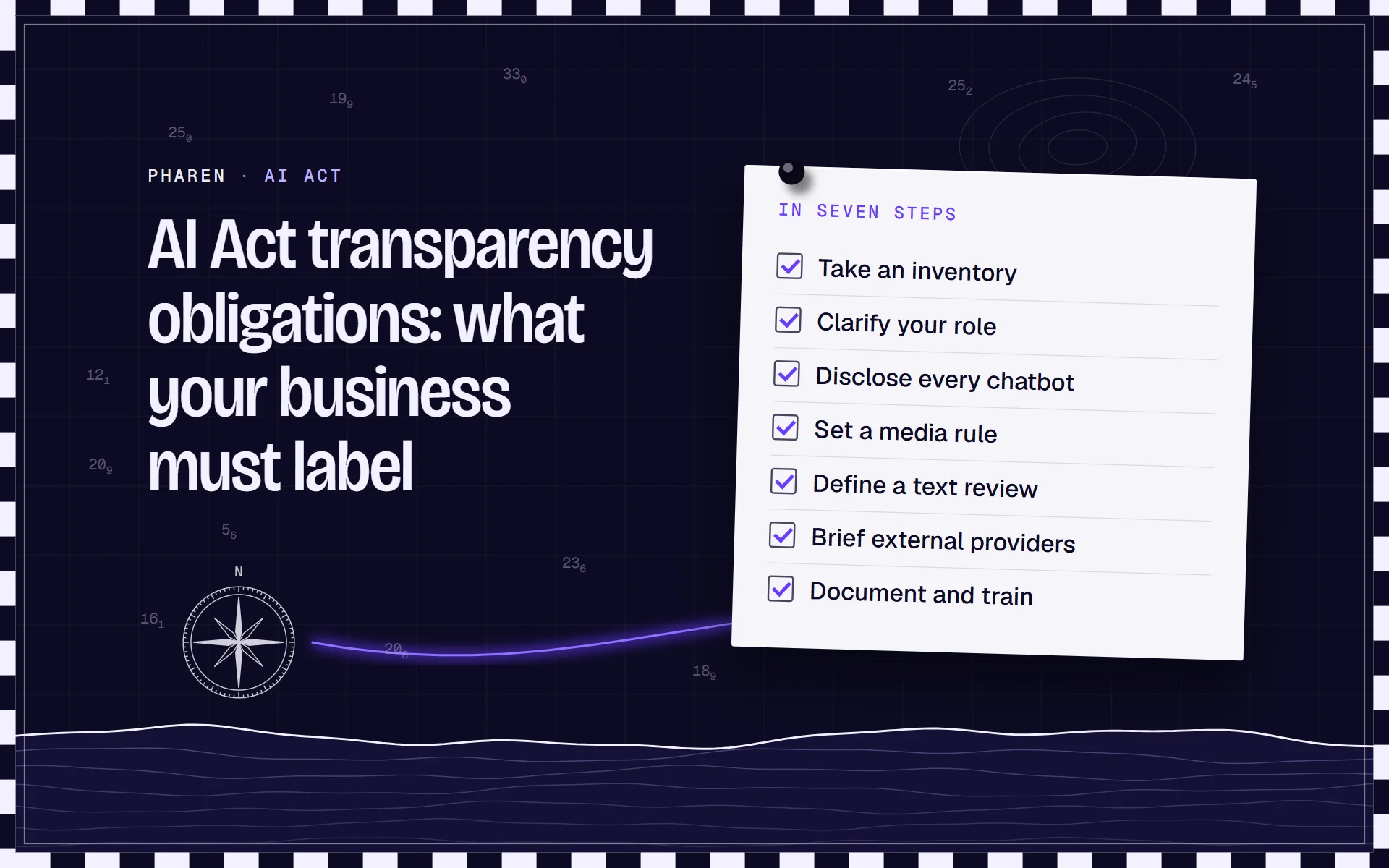
How do you implement Article 50 in seven steps?
This order works for a business with 10 people as well as for one with 200:
- Take an inventory. List every place where AI faces outwards: website, social media, phone, newsletter, job ads, quotes. Ask the agency that runs your Instagram account as well.
- Clarify your role. For each place, decide whether you deploy a third-party tool or offer your own system under your own name.
- Disclose every chatbot. The notice goes into the first message or the first seconds of a call. One sentence is enough if people can clearly see or hear it.
- Set a media rule. If AI content shows a real person, place or event in a way that looks real, the words “AI-generated” go directly on the content.
- Define a text review. Decide who checks the substance before an AI text on a public-interest topic is published, and record who reviews and who is responsible.
- Brief external providers. If an agency creates content with AI for you, you remain the deployer. Put in the contract that it tells you where AI was used.
- Document and train. The rules go into your AI acceptable use policy, and the team learns them in a short training session. Set a date to repeat the inventory.
Worked example: what does implementation cost?
Take an online retailer with 10 employees. AI is used in 5 places: a chatbot in the shop, AI product images, a newsletter, Instagram posts and reply drafts in customer service. Our assumptions for the effort:
- Inventory and role check: 3 hours for management and marketing
- Chatbot notice and a label template for images: 2 hours
- Review step for the newsletter and a paragraph in the policy: 2 hours
- Team briefing: 10 people for 30 minutes each, 5 hours
That is 12 hours in total. At €45.00 per hour, the average labour cost per hour worked in Germany in 2025 according to the Federal Statistical Office (Destatis), implementation costs about €540 in working time. Two of the five places end up with a label: the chatbot, and the product images that show realistic AI-generated people.
Where are the limits?
A notice in the wrong place does not meet the duty. A sentence in the privacy policy reaches nobody at the first interaction with a chatbot, and paragraph 5 asks for exactly that moment. Relying on the tool’s watermark is the second gap, because it is not enough for deepfakes.
A review that exists only on paper is a third risk. If the “human review” of an AI expert text consists of someone clicking “publish”, the exception does not apply. Labelling every email “AI-assisted” as a precaution breaks no rule, but it weakens the label in the cases where it matters.
This overview has limits of its own. Binding decisions are made by authorities and courts. In Germany the Bundesnetzagentur, the Federal Network Agency, has been the market surveillance authority for the AI Act since 29 July 2026 and also monitors the transparency obligations in its area. For borderline cases such as product images or avatars there is little practice so far. If you use AI only internally, you need no labels, only a clean inventory.
Frequently asked questions about AI Act transparency obligations
Do I have to label AI-generated text?
Only in one case: when an AI text is published to inform the public on a matter of public interest and no person has reviewed it and taken editorial responsibility. Emails, quotes, product texts and internal documents are not covered.
Does a chatbot have to disclose that it is an AI?
Yes, if it interacts directly with people and this is not already obvious. The notice has to come at the start of the first interaction at the latest and has to be clearly visible. A sentence in the first message usually covers it.
Do I have to label AI images on Instagram?
Yes, if the image shows real people, places, objects or events in a way that falsely appears authentic. It is then a deepfake, and the notice belongs visibly on the post. A recognisably drawn illustration needs no notice under Article 50, although the platform’s own rules may ask for more.
What are the penalties for breaching Article 50?
The Commission names fines of up to €15 million or 3% of worldwide annual turnover, with proportionality for small and medium-sized enterprises. National authorities enforce the rules, in Germany mainly the Bundesnetzagentur.
Do the transparency obligations apply to older content?
No. According to the Commission, content created before 2 August 2026 does not have to be labelled retroactively. It encourages labelling where possible.
Summary
Article 50 leaves most businesses with two or three places that need a notice and a review step for texts that go out to the public. In the worked example, the inventory takes three hours and the whole implementation about 12. If you want to know where labels are missing in your business, or want an AI agent that discloses itself from the first message, see our implementation service or get in touch.