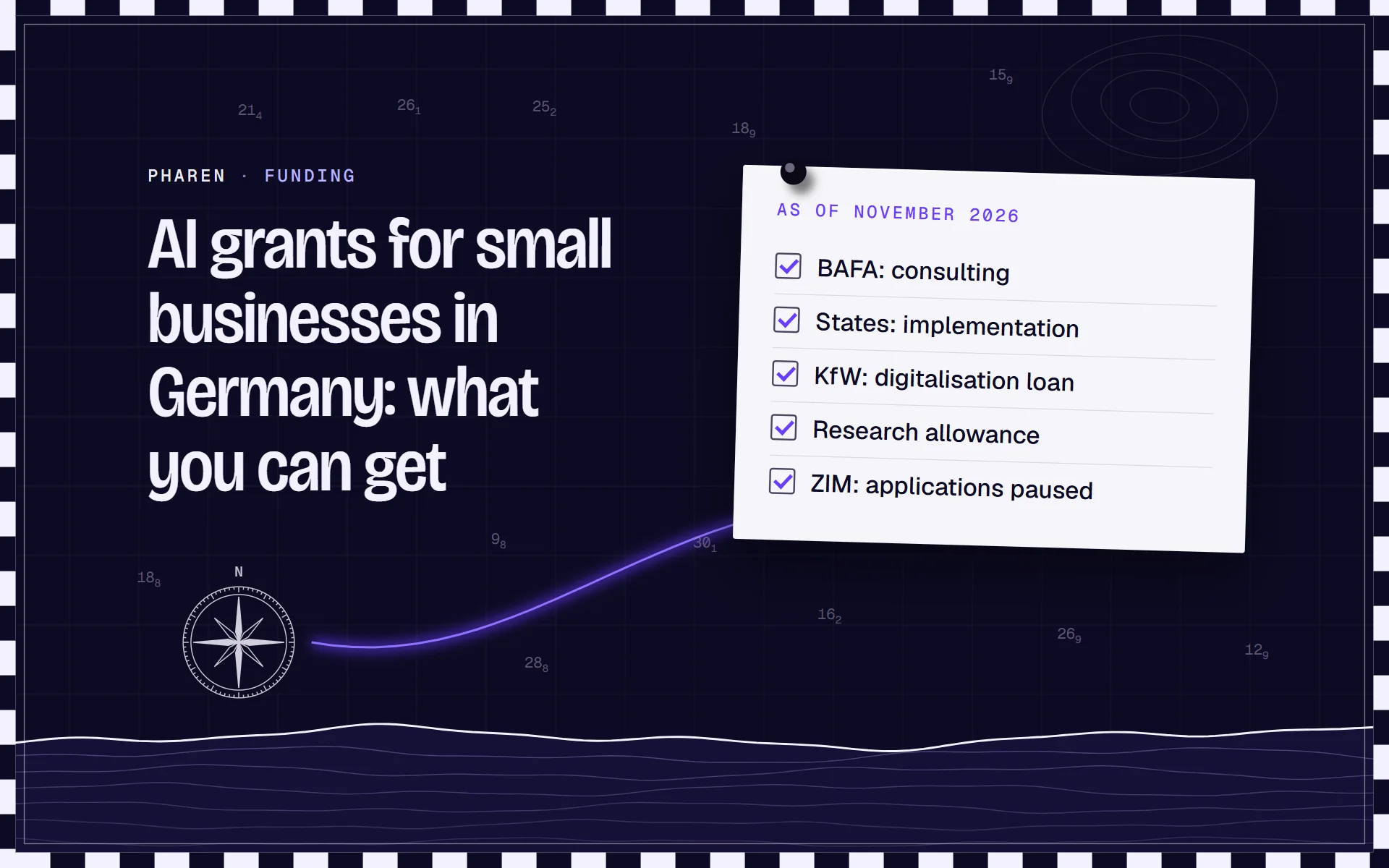
AI grants for small businesses in Germany come in four forms as of November 2026: grants for consulting, grants for implementation, subsidised loans and a tax allowance for development work. From January 2027 the federal office BAFA pays up to €2,800 towards AI consulting, and some federal states cover up to half the cost of putting a project into practice.
How much of that reaches you depends heavily on where your business is. Two well-known programmes are currently closed to new applications: the federal ZIM innovation programme since July 2026, and the Saxon digitalisation grant in ten of the state’s thirteen districts and cities. Below we sort out what is open, what it is worth and where the catches are. Everything here reflects the position on 23 November 2026.
What are AI grants for small businesses?
The term covers public money that pays part of the cost when a company plans, introduces or develops AI. At the moment there is no dedicated AI programme for small and medium-sized enterprises in Germany. The AI funding programme launched by the Federal Ministry of Labour in September 2026 is aimed at research institutions and project sponsors, and its deadline passed on 14 October. Business AI projects therefore run through general programmes for consulting, digitalisation and innovation.
One question sorts the options quickly: what are you spending the money on? The answer decides which programme can apply at all.
| Spending on | Example programme | Type | Status, November 2026 |
|---|---|---|---|
| Consulting | BAFA consulting grant | Grant | Open, new rules from 2027 |
| Implementation | Digi-Z (Saxony), Digitalbonus (Bavaria) | Grant | Depends on state and region |
| Investment | KfW ERP digitalisation loan | Loan | Open |
| Development | Research allowance, ZIM | Tax, grant | Allowance open, ZIM paused |
Training has its own rules. The Federal Employment Agency, for example, only funds courses of more than 120 hours and does not fund training on company-specific software. Short team courses such as our AI workshops therefore fall outside that route.
Consulting: what BAFA pays from 2027
The Federal Office for Economic Affairs and Export Control (BAFA) amended its guideline on funding business consulting in October 2026. The new version applies from 1 January 2027, with proof of use accepted until the end of 2028. The main points from the BAFA guideline:
- Eligible consulting costs are capped at €3,500 and 40 hours.
- In the eastern German states the grant is 80 per cent, up to €2,800. Berlin and the Leipzig region are excluded from this rate.
- In the western states, Berlin and the Leipzig region the grant is 50 per cent, up to €1,750.
- Only one-to-one consulting qualifies. Seminars, workshops and group sessions are excluded.
- The consultant must be registered with BAFA. Advice aimed at selling the consultant’s own products or services is not funded.
- A company can claim two funded consultations a year and five in total.
Small and medium-sized enterprises with fewer than 250 employees and turnover of no more than €50 million, or a balance sheet of no more than €43 million, are eligible. The grant counts as de minimis aid. From 2027 applications go through Elster or BundID only, and the previous meeting with a regional partner is dropped.
The order of steps causes the most trouble. Consulting may only start after BAFA has sent its information letter, and signing the consulting contract already counts as the start. Sign too early and the grant is lost. After the consulting you have six months to submit proof of use.
For AI projects this grant suits an assessment of where AI could help, or a review of your processes by a registered consultant. A team workshop does not qualify. That includes our own AI strategy workshops, which are workshops and therefore outside BAFA’s scope.
Implementation: state grants and the KfW loan
The actual implementation, meaning software, setup and rollout, is the responsibility of the federal states. Each state runs its own programmes with its own limits, and the federal funding database (Förderdatenbank) lists them. Two examples show how far the rules differ.
Saxony. The Digitalisierungszuschuss from the Saxon development bank SAB, known as Digi-Z, covers planning, technical implementation, software and rollout. Micro businesses can receive up to 60 per cent on introductory projects, with direct costs capped at €10,000. For larger transformation projects, small businesses receive up to 50 per cent on up to €60,000, and medium-sized ones up to 35 per cent on up to €100,000. A flat 7 per cent for indirect costs is added to the direct costs. Projects must be worth at least €5,000 and finish within twelve months. Pure consulting is not funded.
The catch: since 17 July 2026 SAB has stopped taking applications from its transition region. The grant is only open to the city of Leipzig, the district of Leipzig and Nordsachsen. Dresden, Chemnitz and the remaining eight districts are closed.
Bavaria. The Digitalbonus Bayern runs until the end of 2027 and is aimed at small businesses with fewer than 50 employees and turnover or a balance sheet of no more than €10 million. The standard version pays up to €7,500, and the Digitalbonus Plus pays up to €30,000 for projects with particular innovative content, in both cases up to half the cost. Measures with eligible costs below €4,000 are excluded. Funds are released in monthly allocations, and you need an Elster business account to apply.
Federal level. Where no state grant applies, there is the KfW ERP digitalisation loan. It finances investment and running costs for digitalisation and names AI explicitly. Loans go up to €25 million, and depending on the tier a grant of 3 or 5 per cent of the loan amount can be added, up to €200,000. You apply through your own bank, not directly with KfW. For a €20,000 project this is no windfall, but it does spread the cost.
Development: research allowance and ZIM
If you develop AI yourself, such as your own model or a new method, the innovation programmes apply. The research allowance (Forschungszulage) is a tax incentive. It is 25 per cent of eligible costs, or 35 per cent for small and medium-sized enterprises. For costs incurred after 31 December 2025 the assessment base is €12 million, and the owner’s own work is valued at €100 rather than €70 per hour. A separate body, the BSFZ, certifies in advance whether a project counts as research and development.
A short example: a company with 40 staff puts two people on developing its own AI-based inspection method for a year, at a personnel cost of €120,000. If the project is certified, 35 per cent of €120,000 gives an allowance of €42,000, plus a flat rate for overheads. In our view, configuring an off-the-shelf language model for your own bookkeeping is unlikely to count as research.
The Central Innovation Programme for SMEs (ZIM) was long the first port of call for such projects. Since 7 July 2026 a temporary stop on applications has applied to all project types. Only calls with international partners are exempt. New applications are planned for early 2027, depending on the 2027 federal budget.
Worked example: one AI project in three locations
A worked example shows how much location matters. A company with 25 employees plans an AI project in two parts: one-to-one consulting costing €3,500, followed by implementation costing €20,000. We assume that all conditions are met, that consulting and implementation come from different providers and that all amounts are net of VAT. We place the company in Leipzig, in Chemnitz and in Bavaria.
- Leipzig (city). BAFA pays 50 per cent of the consulting, so €1,750. Digi-Z takes €20,000 plus the 7 per cent flat rate, €21,400 in total, and pays half: €10,700.
- Chemnitz. BAFA pays 80 per cent, so €2,800. Digi-Z is currently closed there, which leaves the KfW loan.
- Bavaria. BAFA pays 50 per cent, so €1,750. The standard Digitalbonus is capped at €7,500. The Plus version would pay €10,000 if the project is judged particularly innovative.
| Location | BAFA consulting | Implementation grant | Own share of €23,500 |
|---|---|---|---|
| Leipzig | €1,750 | €10,700 | €11,050 |
| Chemnitz | €2,800 | €0 | €20,700 |
| Bavaria | €1,750 | €7,500 | €14,250 |
The same project costs the company between €11,050 and €20,700. The location with the highest consulting grant is the most expensive here, because it has no implementation grant. The example is unrelated to our own prices. A first AI agent with us starts at €1,999, paid once, which on its own sits below the Digi-Z minimum.
How to approach a grant application
The order of steps often matters more than the choice of programme. These five steps work well:
- Describe the project. Write down which process you want to improve, what it costs today and what you would need to buy or build.
- Split the costs. Divide the project into consulting, implementation, training and development. Each part has its own programmes.
- Check the programmes. Look up what is open for your location and read the guideline yourself. Allocations and application stops can change within weeks.
- Apply before you sign. Submit the application and wait for confirmation before you sign or pay anything. For BAFA and Digi-Z, the contract already counts as the start.
- Keep the paperwork. Keep quotes, contracts, invoices and proof of payment. Without proof of use there is no money.
A good first candidate is a process with clear volumes and costs. Our article on automating incoming invoices shows what such a process looks like in a small business, and the case study on the invoice process shows the result.
Limits of public funding
Funding makes a project cheaper, rarely faster. Weeks pass between application and confirmation, and you may not start in that time. For a small automation that could be running in two weeks, that is often a poor trade.
Then there is the ban on double funding. The same costs may not be paid from two public sources. Consulting and implementation can be funded separately, a single invoice only once. BAFA adds the neutrality rule: if the same provider advises and then implements, the consulting grant may be at risk. Clarify this beforehand.
Finally, the rules keep changing. This year two large programmes were paused and one was rewritten. What we describe here reflects 23 November 2026 and is not legal or tax advice. The guidelines and the official decisions are binding.
Frequently asked questions about AI grants
Is there a funding programme just for AI?
Not for small and medium-sized enterprises at the moment. The Federal Ministry of Labour’s 2026 AI programme is aimed at research institutions and project sponsors. Businesses use the general programmes for consulting, digitalisation and innovation.
Does BAFA fund an AI workshop?
No. The guideline funds only one-to-one consulting and explicitly excludes seminars, workshops and group sessions. Training has its own routes, such as the Federal Employment Agency for longer courses.
Can I place the order before the grant is confirmed?
Usually not. For BAFA and the Saxon Digi-Z, signing the contract already counts as the start, and starting early costs you the grant. Wait for the information letter or the confirmation.
Can I combine several programmes?
Yes, if they cover different costs. BAFA consulting and implementation through a state programme fit together. Having the same invoice funded twice is prohibited.
When will ZIM accept applications again?
The target is early 2027, depending on the 2027 federal budget. Until then all project types are paused, apart from calls with international partners.
Summary
Public money for AI exists in Germany, but it is spread across many programmes and depends heavily on location. From 2027 BAFA is the most reliable route for consulting, your state decides on implementation, and the research allowance covers your own development work. If you check early and apply before you sign, you can save more than half the cost. If you are in a hurry, work out the numbers once without any grant. If you would like to know which route suits your project, get in touch.