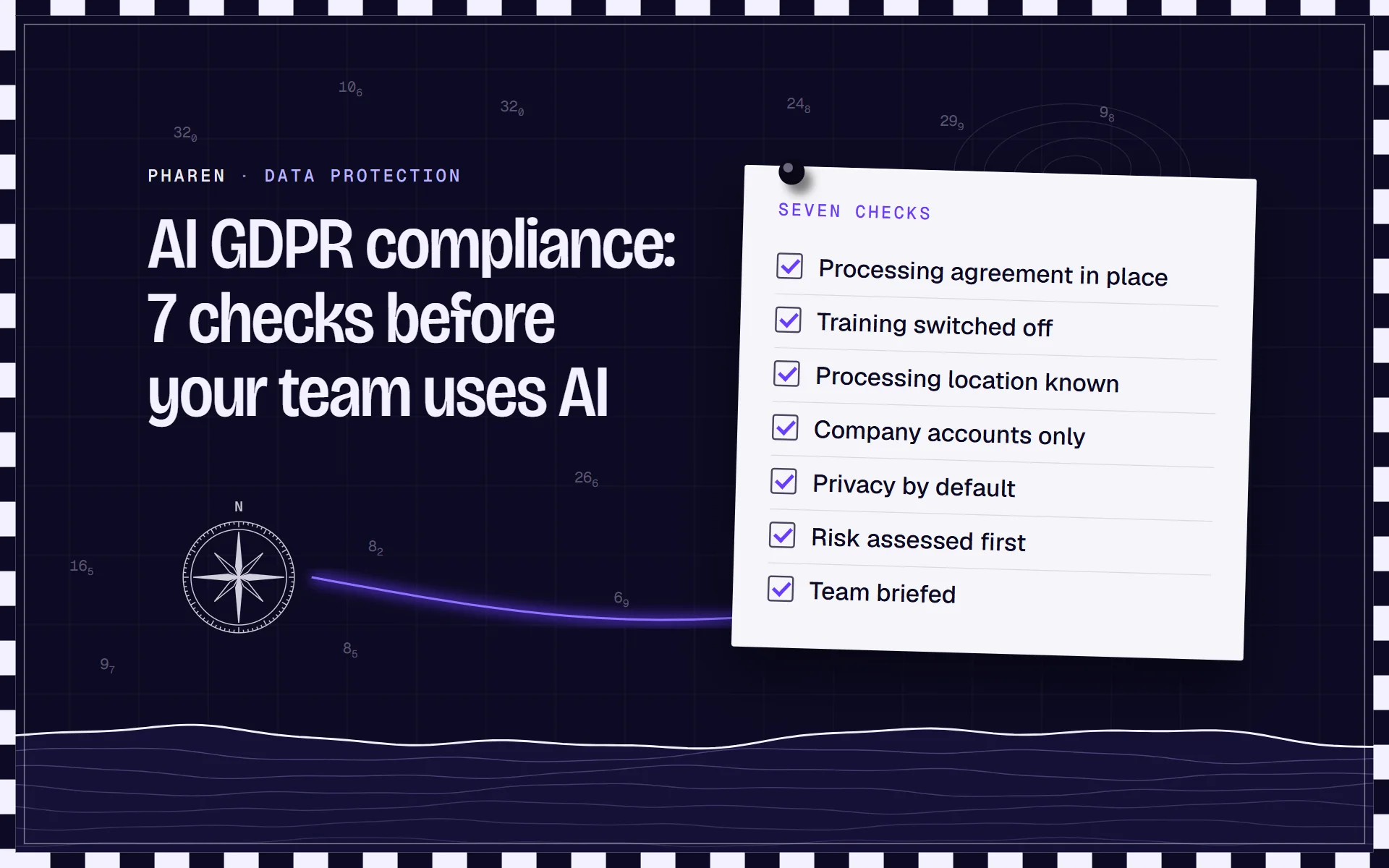
AI GDPR compliance is a result of how you set up and use a tool, and Germany’s data protection authorities set out what that involves in guidance published on 6 May 2024. A business uses AI in line with the GDPR when a data processing agreement is in place, inputs do not flow into model training, transfers to countries outside the EU are covered and the team knows which data may go in. This post turns the guidance into a checklist with 7 checks.
Many businesses hold back on AI because of data protection. In a survey of 603 companies with 20 or more employees by Bitkom, Germany’s digital industry association, 66% of the companies that use AI name data protection requirements as an obstacle, and 45% fear that company data could end up in the wrong hands (published September 2026).
This post is not legal advice. It helps you ask the right questions before your data protection officer signs anything, and it reflects the position as at November 2026.
What does AI GDPR compliance mean?
GDPR compliance describes how your business processes data, and no product can provide it by itself. A provider can run its servers in Frankfurt and still be used in a way that breaks the rules. A service from the United States can be lawful with a contract, the right settings and a legal basis for the transfer.
The yardstick for German businesses is the guidance Künstliche Intelligenz und Datenschutz (AI and data protection) from the Datenschutzkonferenz, or DSK. The DSK is the conference of Germany’s independent federal and state data protection authorities. Its guidance is available in German only and is meant to help businesses select, introduce and use AI applications, with a focus on large language models. The authorities state that it is not an exhaustive list of requirements.
Two terms from the GDPR matter for everything that follows. The controller decides on the purposes and means of the processing, and that is your business. The processor is the provider that runs the AI as a cloud service for you and acts on your instructions.
The GDPR is one set of rules. The EU AI Act adds others, such as the labelling duties for chatbots and generated content described in AI Act transparency obligations.
Is an open or a closed AI system better for data protection?
The DSK guidance distinguishes two kinds of systems. Closed systems run in a separate environment, only a defined group of users has access, you control inputs and outputs, and the provider does not train on your data. Open systems are available on the internet to an open group of users, inputs leave your protected environment, and data often goes to countries outside the EU.
The key sentence for selecting a tool follows from this: technically closed systems are preferable from a data protection point of view. Open systems are not banned, but they need more checks, more contract work and more discipline in the team.
Responsibility also depends on how the AI runs. If you operate an AI application on your own servers for your own purposes, the guidance says you are usually the sole controller. If you use a cloud service, the provider acts on your behalf, and you conclude an agreement with it under Article 28(3) GDPR.
A company account with one of the large providers sits between the two. For ChatGPT, OpenAI’s data controls state that content from Business, Enterprise and Edu workspaces is not used for training by default. On the personal plans, the setting that allows content to improve the models is switched on by default, and each user can switch it off (as at November 2026).
Which 7 checks should every AI tool pass?
The list follows the DSK guidance. Use it for every tool your team uses or plans to use, and write down an answer with its source for each check.
1. Processing agreement in place
If you use an external provider’s AI as a cloud service, the provider usually processes data on your behalf. You then need a contract under Article 28 GDPR, which the large providers often call a Data Processing Addendum. A personal free account usually comes without one, which rules it out for customer data.
2. Training switched off
Check whether the provider uses your inputs and outputs for training, whether it tells you so and whether you can switch it off. If you cannot, and personal data is involved, you need a separate legal basis for that purpose. The guidance says applications that do not train on your data at all are preferable.
3. Processing location known
If data is processed outside the EU, Chapter V of the GDPR on international transfers applies. Ask the provider where data is stored and where it is processed, and get the answer in writing. Microsoft states in its privacy documentation for Microsoft 365 Copilot that EU traffic stays within the EU Data Boundary, but currently excludes models provided by Anthropic as a subprocessor (as at November 2026). The choice of model can therefore change where your data goes.
4. Company accounts only
According to the guidance, employers should provide devices and accounts so that staff do not work with private accounts and no profiles of individual employees are created. If the AI does not run on your own servers, the guidance recommends accounts that do not carry the names of individual employees, with functional company email addresses. If a service asks for a mobile number, the phone should belong to the business as well.
5. Privacy by default
Article 25 GDPR requires data protection by design and by default. As an example, the guidance suggests configuring a new account so that no inputs are used for training and no input history is kept beyond the session. Results should also never be published automatically.
6. Risk assessed first
Before you start, you assess the risk based on the nature, scope, purpose and context of the processing. If the risk is likely to be high, a data protection impact assessment (DPIA) under Article 35 GDPR follows, and according to the guidance this will often be the case when AI is used. The provider has to supply the information on how its system works, so ask for it before you buy.
7. Team briefed
Staff should know through training, written guidance and conversations whether and how they may use AI. The guidance says your data protection officer belongs in every decision about AI applications, and that you should check whether the Betriebsrat (works council, the elected employee body in private companies) or the Personalrat (its equivalent in the public sector) has to be involved. What a briefing can look like is covered in AI literacy requirements and in our workshops.
None of these checks needs specialist knowledge. In practice, the gaps tend to be a missing contract and settings that nobody changed from the default.
Which data may go into which AI tool?
The checklist tests the tool. The second question is what goes into it. We work with a simple four-level classification that you can put in front of your data protection officer. It is a rule of thumb, not legal advice.
| Data | Personal free account | Company account with processing agreement, no training | Own server or own cloud |
|---|---|---|---|
| Public information (website, press release, product sheet) | Yes | Yes | Yes |
| Internal data without personal data (quotes, cost calculations) | No, trade secrets | As your policy sets out | As your policy sets out |
| Customer and supplier data (names, emails, invoices) | No | After a prior check | After a prior check |
| Special categories under Article 9 (health data, personnel files) | No | Only with a DPIA and a legal basis | Only with a DPIA and a legal basis |
The right-hand column looks the same as the middle one, and that is deliberate. Your own server removes the contract with the AI provider and the question of third-country transfers. It does not supply a legal basis for processing patient data.
In practice this looks different by sector. In a trades business, incoming invoices belong in the third row, and in a restaurant, reservations with phone numbers do too. In consulting, enquiries with names and needs sit in the third row, while at an education provider, learning progress can quickly move into the fourth. Once you know the row, you know which account you need.
What does it cost to get AI GDPR compliance right?
Many businesses put the topic off because they expect weeks of work. Take a planning office with 15 employees that currently uses four AI tools, two of them through private accounts.
Our assumptions: an hour of work costs €45.00, which according to the Federal Statistical Office (Destatis) was the average labour cost per hour worked in Germany in 2025. Licences are not included, because they depend on the provider.
- A short survey to take stock: 15 people at 10 minutes each, 2.5 hours in total.
- Checking 4 tools against the 7 checks: 2 hours each, 8 hours in total.
- Writing and agreeing a policy: 6 hours.
- Briefing: 1 hour for each of the 15 people plus 2 hours of preparation, 17 hours in total.
- Review by the data protection officer: 2 hours.
That adds up to 35.5 hours, or about €1,600 of internal working time, roughly €107 per person. A review every six months takes around 4 hours, or €360 a year.
The other side of the calculation is harder to put a figure on. A business that sends customer data through a private account without a contract has a problem that no cheaper plan will fix.
What does a clean data flow look like?
You can recognise a clean data flow by the fact that it fits into three sentences. At Hobeck, a roofing company in Belgern in Saxony, about 160 incoming invoices a month arrive by email or upload, and an agent team in Pharen Hub reads the details and suggests the matching job site. Above a set amount, management approves, and only then do the document and data go to DATEV, the accounting software that many German tax advisers work with, while payment and bookkeeping stay with people. The full process is described in the incoming invoice case study.
Write a flow like this down for every tool. Which data goes in, where is it processed, who sees the result and where does it go next? Anything you cannot describe in those sentences has usually not been checked either.
For this reason Pharen Hub can run in two ways. Either we host it in Germany on Hetzner Cloud, with updates, backups and maintenance, or it runs in your own cloud on Azure, AWS, Google Cloud or Hetzner, on your own server or in Kubernetes. Nothing in your workspace goes into any training.
We still do not give a blanket answer on whether that makes your use GDPR compliant. It depends on the whole setup: which models you use, whether GPT, Claude, Gemini or Mistral, where the Hub runs and which data goes into it. We work that out with you before we start and put it in writing.
Where does the checklist end?
The seven checks cover selecting and introducing a tool. They do not replace a DPIA, a legal basis for special categories of data or legal advice. For health data, job applications or performance reviews of staff, bring in a data protection lawyer before the first document is uploaded.
Three mistakes are easy to make. A server location in Germany is taken for a contract. Training is switched off in the company account, but half the team keeps working in private accounts. And AI results about people are used without being checked, although the guidance explicitly requires checking them for accuracy before any further processing.
Sometimes the honest answer is to leave AI out of a process altogether. If a process consists almost entirely of specially protected data and no closed system is available, securing it often costs more than it brings. In that case, start with a process from the first or second row of the table.
Frequently asked questions about AI GDPR compliance
Is ChatGPT GDPR compliant?
That depends on the account and on how you use it. According to OpenAI, Business, Enterprise and Edu workspaces are not used for training by default, while on personal plans content can be used to improve the models unless the user switches this off (as at November 2026). Whether your use is lawful depends on the contract, the settings and the data you put in.
Is a server in Germany enough for GDPR compliance?
No. The location only answers check 3. Without a processing agreement, without clarity on training and without rules for the team, a server in Nuremberg does not make your use compliant either.
Do we need a DPIA for every AI tool?
Not for every tool, but every tool needs a prior risk assessment. If that assessment shows a likely high risk, the DPIA is mandatory, and according to the DSK guidance this will often be the case with AI. An assistant that only rewords public texts is assessed differently from one that reads personnel files.
May employees use private AI accounts for work?
The German authorities advise against it for business data. Employers should provide devices and accounts so that no profiles of individual staff are created. State in your policy which accounts are allowed and provide them, otherwise the team keeps using what it knows.
What happens if the AI writes something wrong about a person?
Under Article 16 GDPR, the people concerned have a right to have inaccurate data about them corrected. This is why the guidance requires results that relate to people to be checked before any further use. Build that check into the process, for example as an approval step by a person.
Summary
No provider can honestly promise that an AI tool is GDPR compliant on its own. You get there yourself, with a contract, the right default settings, a table for your data and a team that knows it. In an office with 15 people, about 35 hours of work cover the groundwork. The rules for the team belong in an AI acceptable use policy.
If you want help with this: in our strategy consulting we decide with you which data goes into which AI and write it down, with workshops from €399 plus VAT. The DPIA stays with your data protection officer. Get in touch to talk it through.