The AI literacy requirements in Article 4 of the AI Act apply to every business whose staff use AI at work. Since 2 February 2025, providers and deployers of AI systems have had to take measures for the AI literacy of their staff; since 27 July 2026 the wording asks them to support that literacy, and since 2 August 2026 national authorities supervise the duty. The law does not demand a specific level, a certificate or an AI officer.
The first version of Article 4 asked businesses to ensure, to their best extent, a sufficient level of AI literacy. Nobody could say when that level was reached. The EU’s Digital Omnibus on AI removed the target in summer 2026, and the duty to act remains.
This guide shows who is covered, what changed in 2026, what training should cover and how to meet and document the duty in six steps, with a cost example for half a day of training. It is not legal advice and reflects the legal position as at November 2026.
What are the AI literacy requirements in Article 4?
Article 4 of Regulation (EU) 2024/1689 is titled “AI literacy”. AI literacy is the knowledge people need to use AI systems in an informed way and to be aware of their opportunities, risks and possible harm. The current text is published on the Commission’s AI Act Service Desk. Providers and deployers of AI systems “shall take measures to support the development of AI literacy of their staff and other persons dealing with the operation and use of AI systems on their behalf”.
In doing so they take into account the technical knowledge, experience, education and training of the people involved, the context in which the AI is used and the people it affects. The text states explicitly that it does not require them to guarantee any specific level of AI literacy of any individual. In practice this means that every person who works with AI gets the knowledge that fits their task, and that you can show you took care of it.
“Training” covers a wide range here. The Bundesnetzagentur, Germany’s Federal Network Agency, lists formats from self-learning programmes, workshops and training courses to multi-staged advanced training, run internally or externally. You choose the format that fits your business.
Who do the AI literacy requirements apply to?
The Bundesnetzagentur names providers and deployers of AI systems, irrespective of the sector or the size of the business. If your business uses ChatGPT, Copilot or an AI translator for work, it is a deployer and the duty applies.
A few typical cases show how wide that is. In a trades business, the office manager drafts quotes with AI, and the master craftsman photographs damage and lets an AI suggest the measurements. In a restaurant, management writes menus and job ads with AI, and an ordering assistant answers questions on WhatsApp. A consulting team summarises meeting notes with Copilot and drafts client letters. Trainers at an education provider create worksheets and quiz questions with AI, and a retailer has product texts and customer service replies written with it.
The duty also covers contractors and service providers who work with AI on your behalf, so the freelancer who writes your newsletter with AI is included. A business that uses no AI at all has no duty under Article 4. How many employees in Germany already use private AI accounts at work is shown in our guide to the AI acceptable use policy.
What changed in Article 4 in 2026?
Regulation (EU) 2026/1744, the Digital Omnibus on AI, entered into force on 27 July 2026 and rewrote Article 4. The main differences:
| Point | Wording until July 2026 | Position since 27 July 2026 |
|---|---|---|
| Goal | Ensure, to their best extent, a sufficient level of AI literacy | Take measures to support the development of AI literacy |
| Level | “Sufficient level”, without a definition | No specific level of any individual has to be guaranteed |
| Support | Not covered | Commission and Member States support businesses, in particular SMEs |
| Supervision | Duty applied, authorities not yet supervising | National authorities supervise since 2 August 2026 |
The Commission also publishes practical examples. Its questions and answers on AI literacy point to a repository of more than 40 AI literacy initiatives from companies and public bodies. The same page states that no certificate is needed, that an internal record of trainings is enough and that no specific governance structure, such as an AI officer, is required.
The AI Act itself sets no fine for Article 4. Article 99 leaves penalties to the Member States, and its tier of fines of up to €15 million lists other articles, Article 50 among them, but not Article 4. According to the Commission, national penalties have to be proportionate. In a liability case a court can still ask what you did. The Bundesnetzagentur states that a lack of AI literacy can be seen as non-compliance with a duty of care, in particular if harm results, and your training records then count.
So if someone offers you a mandatory AI certificate, the law asks for no such thing. The certificate of attendance from our own workshop is a record for your files and nothing more.
What should AI literacy training cover?
The Commission recommends tailoring the content to role, risk, prior knowledge and context. Someone who summarises emails needs different knowledge from someone who builds agents or uses AI in decisions about job applicants. Our workshops are split along these roles:
| Role | What they need to know | Format |
|---|---|---|
| Everyone who uses AI | How AI works, where it goes wrong, what must not go in | Half a day of basics with exercises |
| Sales, marketing, customer service | Checking texts, protecting customer data, labelling | One day with your own cases |
| People who build assistants or agents | Instructions, knowledge sources, tests, limits | One day of practice |
| Management | Duties, risks, policy, priorities | Half a day |
Basics for everyone
Every person should know that a language model calculates probabilities and does not look up facts. The most important rule of the whole training follows from that: whatever the AI returns is a draft.
Your own rules
Training also covers your own rules: which tools are approved, which data may go in and who approves. Anyone handling customer data needs the basics of the GDPR, covered in AI GDPR compliance. Anyone publishing content needs to know the labelling duties from Article 50, explained in AI Act transparency obligations.
Practice on real tasks
The third part is the one that changes daily work. A typical customer email, a receipt or an enquiry from your own business is processed with AI and then checked together. The Commission notes that relying on the instructions for use of an AI system alone is often not effective.
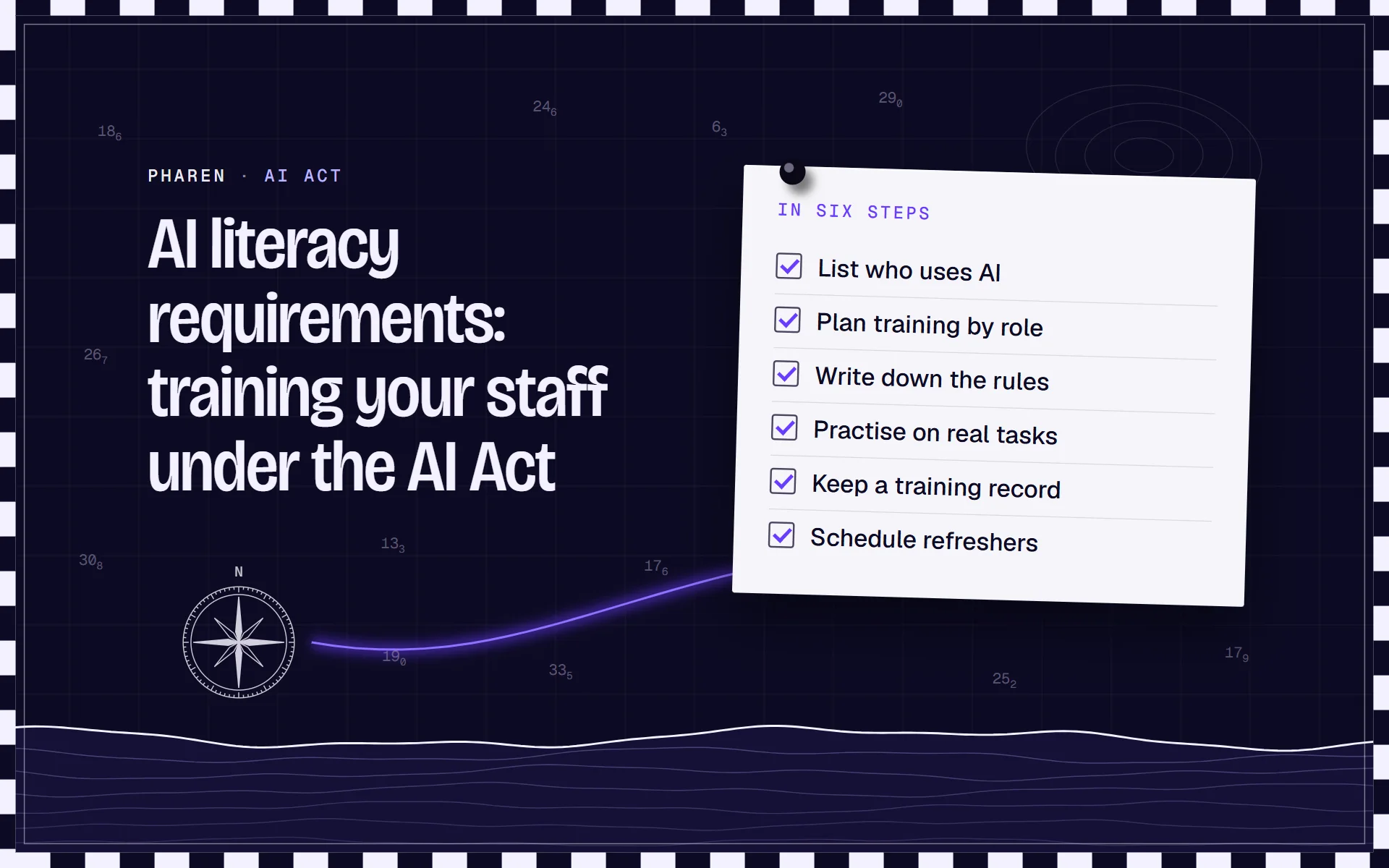
How do you meet Article 4 in six steps?
The Bundesnetzagentur leaves the format to you. This sequence works for most businesses:
- List who uses AI. Record who uses which AI tool for what, including freelancers and service providers.
- Plan training by role. Give everyone basic training, plus deeper sessions for those who do more with AI, as in the table above.
- Write down the rules. Note the approved tools, which data may go in and who checks. Without written rules, the team does not know after the training what applies in your business.
- Practise on real tasks. Each group brings two or three of its own cases, including examples of where AI gets things wrong and what must never go into an AI tool.
- Keep a training record. The Bundesnetzagentur recommends documenting the type, content and duration of each measure and who took part. A table with date, topic, duration and names is enough, filed together with the materials.
- Schedule refreshers. New staff get the basic training when they join, and new tools get a short briefing. The Bundesnetzagentur calls AI literacy an ongoing process with regular evaluation, and a fixed date once a year to review the list, the rules and the training is one way to meet that.
What does half a day of AI literacy training cost?
Take an office with 10 people who all work with AI. The Federal Statistical Office (Destatis) puts the average labour cost per hour worked in Germany in 2025 at €45.00. Half a day of 4 hours therefore costs 10 × 4 hours × €45.00, or €1,800 in working time. Add the trainer’s fee, with us from €499 per session plus VAT, for a total from about €2,300. Other formats, their prices and the funding options are compared in our guide to AI training for employees.
Assume that after the training each person saves 15 minutes a week, because they check drafts faster and fewer errors come back. That is 10 × 0.25 hours × €45.00, or €112.50 a week. The half day has paid for itself after about 20 weeks, and after about 40 if you halve the assumption. Whether your team saves 15 minutes or more depends on its tasks, and the saving only appears when people practise on real ones.
The incoming invoice process at Hobeck, a roofing company in Saxony, shows the habit that training should build. An agent team reads about 160 invoices a month, and validation rules stop about four possible duplicates a month before payment. Above a set amount, management approves, and that rule is part of the workflow. A person passing on AI output needs the same two questions: where could this be wrong, and who looks at it again? The story behind the project is told in automating incoming invoices.
Our AI literacy training under the EU AI Act takes half a day and works with your examples. It covers GDPR, customer data and copyright, and every participant receives a certificate of attendance. In and around Leipzig we come to you; elsewhere the training runs remotely.
Where are the limits?
A one-off training is the first weak point. A workshop in spring is followed by new people and new tools, and nobody refreshes the knowledge. The Bundesnetzagentur explicitly recommends regular evaluation and refreshers where needed.
A mandatory video on its own is the second. An e-learning course with a final quiz is quick to roll out and leaves a neat entry in the training record. Whether anyone can then spot an invented source in an AI text is a separate question.
Training without rules is the third. People who learn what AI can do, but not what is allowed in your business, may try it out with a private account.
For high-risk AI, Article 4 is only the starting point. If you deploy AI in decisions about staff or applicants, for example, Article 26 adds duties, among them that the people overseeing the system are sufficiently trained, as the Commission points out. Half a day of basics is not enough for that, and legal advice is worthwhile. For most small and mid-sized businesses that use text assistants and automations, Article 4 is the relevant rule.
Frequently asked questions about AI literacy requirements
Is AI training mandatory for employees?
Yes, if your employees use AI systems at work. Article 4 of the AI Act has required measures for their AI literacy since February 2025, and since July 2026 in the form of supporting that literacy. You decide which format the measures take, from self-learning programmes to workshops.
Do we need an AI literacy certificate?
No. The European Commission and the Bundesnetzagentur both state that no certificate is required. An internal record with date, content, duration and participants is enough, kept together with the training materials.
Do we have to appoint an AI officer?
No, Article 4 does not require one. A named contact for AI questions, who maintains the list of tools and the rules, still helps. In small businesses this is often the managing director.
What happens if we do not train our staff?
The AI Act sets no fine for Article 4 and leaves penalties to national law. If harm occurs, a lack of AI literacy can be seen as a breach of a duty of care, according to the Bundesnetzagentur. A complete training record helps you in that situation.
Do the requirements cover freelancers and contractors?
Yes. According to the Bundesnetzagentur, they cover contractors and service providers who work with AI on your behalf. The simplest approach is a clause in the contract in which the provider confirms that its staff are trained. Freelancers who work inside your team join the same training as everyone else.
Summary
Since summer 2026 the AI Act no longer sets a target level for AI literacy. The duty to act remains, and for most businesses a list of users, half a day of practice, written rules and a training record are enough to meet it. One goal is worth setting anyway: every person on the team knows what they may type into an AI tool and what they may not. If you want to train your team on your own cases, get in touch.