An AI acceptable use policy sets out which AI tools your team may use, which data may go into them and who checks a result before it leaves the business. According to Bitkom, only 23% of German companies with 20 or more employees had such rules in 2025, although far more of them already work with AI. A good policy fits on two pages and can be drafted in an afternoon.
Bitkom is Germany’s digital industry association. Its figures show a gap between use and rules, because staff use AI tools whether or not anyone has set rules for them.
This guide covers what belongs in an AI acceptable use policy, whether you are required to have one, what a data traffic light looks like and how to write the policy in six steps so that people follow it. It includes a sample excerpt for a trades business and a cost estimate. It is not legal advice, and the legal position is as at November 2026.
What is an AI acceptable use policy?
An AI acceptable use policy is an internal rule for how AI tools are used in your business. It answers three everyday questions: what may we use, what may go in, and who looks at a result before it goes out. It applies to everyone who works with AI on your behalf, including freelancers and service providers.
It is often confused with three related documents:
| Document | What it covers | Who decides |
|---|---|---|
| AI acceptable use policy | Tools, data, review, contact person | Management |
| Data protection policy | Handling of personal data in general | Management with the data protection officer |
| Works agreement on AI (Betriebsvereinbarung) | Co-determination, for example when a system can monitor performance or behaviour | Management and the works council |
| AI strategy | What you want to use AI for and in which order | Management |
In Germany, a Betriebsrat (works council) is the body that employees can elect in any business with at least five permanent staff, and a Betriebsvereinbarung is a binding agreement between that council and the employer. The policy and the strategy belong together, but you need the policy before the first AI agent goes live.
How many employees already use AI without rules?
A Bitkom survey of 604 companies with 20 or more employees, published in October 2025, shows how far AI use has spread without approval. In 8% of the companies, employees widely use private AI tools for work, in 17% this happens in individual cases, and another 17% suspect it. Only 29% are sure that nobody uses private AI, down from 37% a year earlier.
Only 26% of the companies provide access to generative AI themselves, and among companies with 20 to 99 employees the figure is 23%. Where the business provides no tool, quotes, customer emails and spreadsheets end up in private accounts whose terms nobody in the business has checked.
The numbers are moving. In 2025, 23% of the companies had rules for AI, up from 15% a year earlier, and another 31% were planning them. 24% had not dealt with the topic at all, down from 36%.
The shortest possible policy is a ban. It is quick to write, but staff who save half an hour with AI tend to find a way, on a private phone if necessary. With around a quarter of companies already reporting private use, a ban mostly moves that use out of sight. A policy that makes the approved route the easy one works better: one approved tool with a company account, a traffic light everyone understands and one person to ask.
Is an AI acceptable use policy a legal requirement?
The AI Act does not prescribe a document with this name, and no German law requires one either. Three sets of rules still make a written policy the obvious tool.
Article 4 of the AI Act
Since 2 February 2025, Article 4 has applied: any business that uses AI has to take measures for the AI literacy of its staff, whatever its size. Since 27 July 2026 a revised version applies, under which businesses support that literacy without having to guarantee a specific level. The Bundesnetzagentur, Germany’s Federal Network Agency, requires neither a certificate nor an AI officer and recommends documenting the measures. The European Commission’s questions and answers on AI literacy also state that an internal record is enough. A policy that everyone in the team has read is the first page of that record. The details are in AI literacy requirements.
German Works Constitution Act
Where there is a works council, section 90(1) of the Works Constitution Act (Betriebsverfassungsgesetz) requires the employer to inform it in due time of plans concerning working procedures and operations, explicitly including the use of artificial intelligence. If a system is designed to monitor the behaviour or performance of employees, the works council has a right of co-determination under section 87(1) no. 6. In such businesses the policy often becomes a works agreement.
Transparency obligations since August 2026
Since 2 August 2026, the transparency obligations in Article 50 of the AI Act apply, for example to chatbots and deepfakes. If you run a chatbot on your website or publish AI-generated video, decide once and centrally how you label it, as described in AI Act transparency obligations. The policy is the place to record that decision.
What should an AI acceptable use policy include?
These nine points are enough for most businesses, each in a few sentences:
- Scope. All employees, plus freelancers and service providers who work with AI on your behalf. The Bundesnetzagentur explicitly counts them among the people whose AI literacy you look after.
- Approved tools. Named tools with the type of account, for example the company account for ChatGPT or Copilot. Private accounts are excluded for company data, and anyone who wants to try a new tool knows whom to ask.
- Data traffic light. Which data may go in, set out as green, amber and red in the table below.
- Human review. A person from the team reads everything that goes out before it is sent: quotes, customer emails, posts. No AI makes decisions about people, for example on job applications.
- Labelling. How you label AI text, AI images and chatbots, decided once so that each department does not do it differently.
- Copyright and confidentiality. Do not upload texts or images you have no rights to, and no customers’ trade secrets. Check AI results for copied passages before you use them.
- Contact person. One named person who answers questions and checks new tools. In small businesses this is often the managing director.
- Training and records. How the team is trained, when new people get their briefing and where this is recorded. This way the policy also covers the documentation for Article 4.
- Breaches and review. What happens when someone breaks the rules, and when the policy is reviewed, with a date and a fixed interval such as every six months, because tools change quickly.
The colours of the data traffic light depend on the contracts you have with each provider:
| Colour | Examples | Rule |
|---|---|---|
| Green | Texts from your website, product descriptions, general questions | Any approved tool |
| Amber | Internal documents without names, anonymised figures, drafts | Only tools with a company account |
| Red | Customer and personnel data, contracts, passwords, health data | Only systems with a data processing agreement, passwords never |
Which provider settings and contracts move a tool from amber to red is covered in AI GDPR compliance.
If you do not want to start from scratch, the IHK Schwaben offers a free template in German covering purpose, approved programs, data protection and responsibility. IHKs are Germany’s regional chambers of industry and commerce, and IHK Schwaben is the one for the Swabia region of Bavaria. It points out that the template has to be adapted to your own business.
A rule that is built into a workflow cannot be forgotten. At Hobeck, a roofing company in Saxony, management approves every invoice above a set amount, and that rule sits directly in the incoming invoice workflow we built. In the lead routing for a consulting firm, an agent sorts the enquiries, the workflow sends nobody a message, and people hold the conversations with customers.
Sample excerpt for an electrical contractor
This is what the core could look like for an electrical contractor with 15 employees. The example is invented, and the rules fit many small businesses in this or a similar form:
Approved: ChatGPT with a company account in the office, Copilot in Outlook for everyone with a company laptop.
Data: Green and amber as set out in the traffic light. Red data, meaning customer names, addresses and invoices, only in the invoice workflow, for which a data processing agreement is in place.
Review: The office manager reads quotes and customer emails before they are sent. The owner approves invoices above a set amount.
Questions to: the office manager. New tools only after checking with them.
Version: November 2026, next review May 2027.
Five paragraphs, one page. For a restaurant the tools and the red data would differ, for example reservations with allergy information, and the structure stays the same.
What does it cost to write an AI policy?
Take the electrical contractor with 15 people. Our assumptions for the effort:
- Taking stock of who uses what: 2 hours for the managing director and the office manager
- A draft based on a template: 3 hours
- Agreement and approval: 2 hours
- Presenting it to the team: 15 people at 30 minutes, 7.5 hours
That adds up to 14.5 hours. At €45.00 of labour cost per hour, the average for Germany in 2025 according to the Federal Statistical Office (Destatis), the policy costs about €650 in working time. If you want help with the draft, a strategy workshop with us starts from €399 plus VAT.
There is no measurable gain on the other side, only damage avoided. A customer list is uploaded to a private ChatGPT account in seconds and is hard to get back.
How do you write an AI policy in six steps?
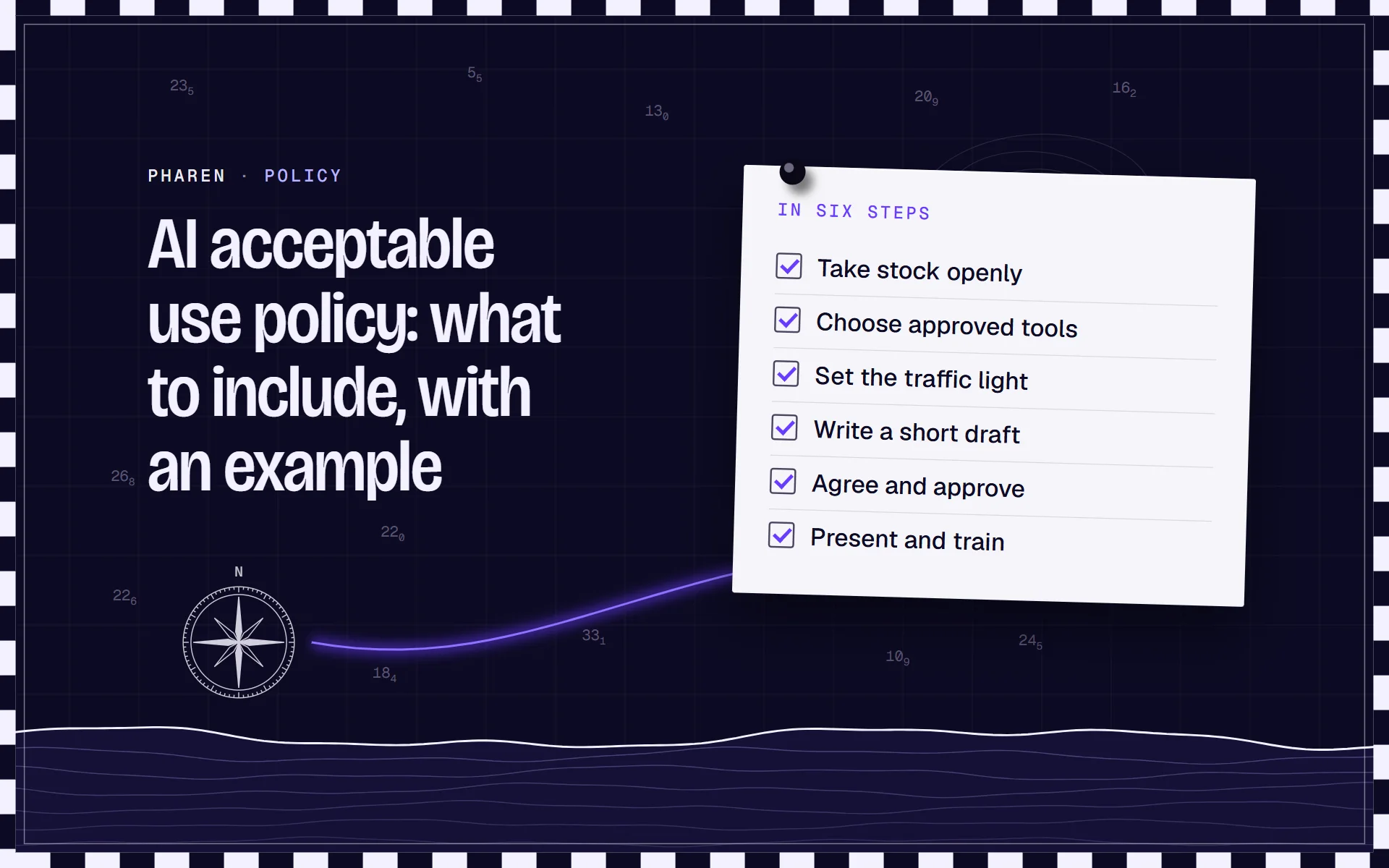
- Take stock openly. Ask who uses which AI for what, with no penalty for honest answers. Otherwise the policy describes what you would like to happen, and something else happens in practice.
- Choose approved tools. Pick one or two tools with a company account and check the contracts, in particular the data processing agreement.
- Set the traffic light. Sort your typical data into green, amber and red, with examples from your daily work.
- Write a short draft. Take a template and cut it down until it fits on two pages. Anything nobody understands comes out.
- Agree and approve. Management, the data protection officer and, where there is one, the works council see the draft before it is approved.
- Present and train. Half an hour with the team, with examples. Anyone who needs more gets AI literacy training with a certificate of attendance for your records.
Where are the limits?
The most common gap is a policy without a tool. If you regulate everything but provide no company account, people go back to their private accounts. The second is a twelve-page policy from the legal department that nobody reads.
The third is a missing review. A policy written in spring does not know the tools of autumn. And a policy does not replace technical measures: protecting sensitive data also takes access rights, contracts and, where needed, a tool that runs on your own servers.
This guide has limits too. It shows the structure, and we do not review contracts or works agreements in it. For personnel data, works council matters or high-risk uses such as AI in recruitment, get legal advice. If you would rather not write the policy alone, our strategy consulting does it with you in one session and puts it in writing.
Frequently asked questions about AI acceptable use policies
Is an AI acceptable use policy a legal requirement?
No, there is no direct legal duty to have one. Article 4 of the AI Act does require measures for your staff’s AI literacy, and a policy is a simple part of that. If you have a works council, its rights to information and co-determination apply as well.
How long should an AI policy be?
Two pages are enough for most businesses. What matters more than length is that every person on the team understands the rules in five minutes. Details such as the list of approved tools can go into an annex.
Can a company ban AI at work?
As a rule, yes, management can decide that. According to Bitkom, staff in many businesses use private AI tools anyway, so a ban often moves the use out of sight. An approved tool with clear rules is usually the safer route.
Does the works council have to be involved?
Where there is a works council, it has to be informed in due time about the planned use of AI. If a system can monitor behaviour or performance, it has a right of co-determination. In those cases a works agreement is often the right form.
Is there a free AI policy template?
Yes, IHK Schwaben offers a free template in German. It has to be adapted to your business, above all the tools, data and responsibilities. A template does not replace taking stock of the tools your team uses.
Summary
A policy does not get any work done on its own. Without one, nobody knows which tools are approved, and people pick their own. Two pages, a data traffic light, a contact person and a review date are enough to start. If you want to write your AI acceptable use policy with us, get in touch.