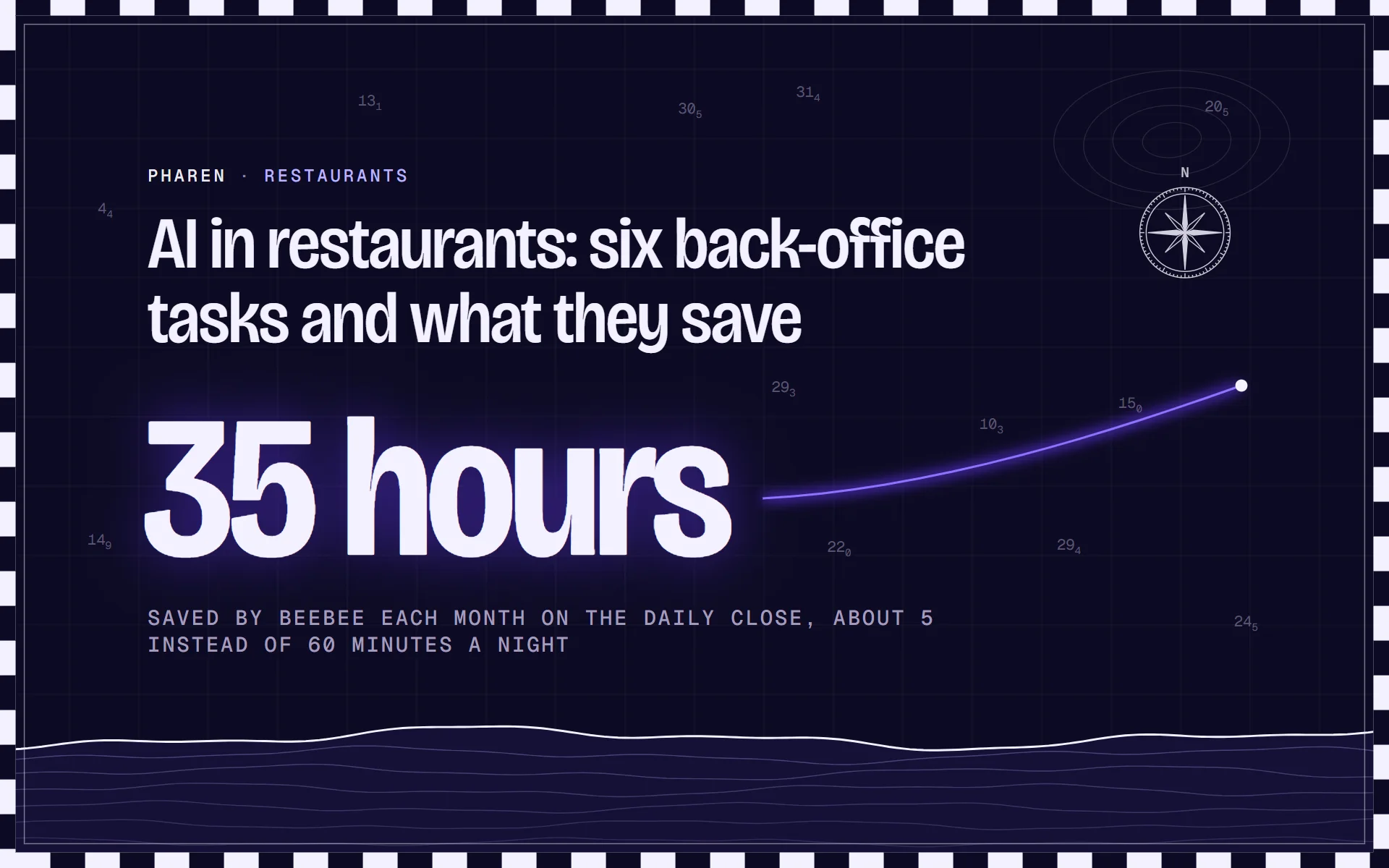
AI in restaurants pays off mainly in the back office: in the daily close, in reconciling till, online shop and delivery platforms, in supplier orders, the staff rota, reservations and replies to reviews. The BeeBee restaurant in Ilmenau saves about 35 hours and about €1,400 a month with an automated daily close, and the core of it does not even need a language model.
At the stove, AI changes little. No model slices salmon, seasons the sauce or calms a table that has waited 40 minutes. The work AI takes off your hands starts after the kitchen closes, when someone opens three systems, copies totals and chases cancellations instead of going home.
Those hours have become more expensive. Germany’s Federal Statistical Office (Destatis) reports that turnover in restaurants and catering fell 2.2% in real terms in 2025 and rose 1.8% in nominal terms. In a survey by DEHOGA, the German hotel and restaurant association, 78.3% of 3,257 hospitality businesses named rising personnel costs as their biggest challenge, and 63.0% counted bureaucracy among the biggest. The German minimum wage has been €13.90 an hour since January 2026 and rises to €14.60 in 2027.
What does AI in restaurants mean?
The term covers three very different things, and the numbers depend on which one you mean. Most good restaurant processes combine the first two, with rules for the figures and a model for the text.
Automation with fixed rules. A workflow pulls figures from the till, online shop and delivery platforms, maps them to the same fields, adds them up and checks whether payouts and orders match. That is pure arithmetic, and a language model would only add cost and uncertainty.
AI that reads and writes. A language model understands a supplier email, a booking request for 25 people with three allergies or a two-star review, and writes a draft. This is where AI is strong, with free text that fits no field.
Features in the till system. Many till and reservation systems come with their own reports and forecasts. Before you build anything, check what your system already does. Building only makes sense where two systems need to talk to each other and do not do so on their own.
Which tasks can AI and automation take over in a restaurant?
Six tasks come back every day or every week. For each one, here is what a rule does, what a model does and what stays with the team.
Daily close after the kitchen shuts
The daily close puts each day’s orders, revenue, cancellations and payment methods side by side for the accounts. A workflow takes the daily totals from all sources, writes them into one shared overview and closes a day without discrepancies by itself. The team only looks at the exceptions, and no language model is needed.
Reconciling platform payouts
Every delivery platform keeps its own order lists and pays out later, minus commission and often bundled for several days. That is where money goes missing.
The reconciliation checks fixed rules. Does the payout match the orders once listed fees are deducted? Does every cancellation have a reason?
Anything that does not match becomes an open item with source and amount. AI only helps if a platform sends its statements as PDFs that need to be read.
Supplier orders
The daily close tells you what was sold. Together with stock levels and your minimum quantities, that gives an order suggestion, which the head chef checks and sends. An agent can also read order confirmations and delivery notes from the inbox and flag when a delivery differs from the order.
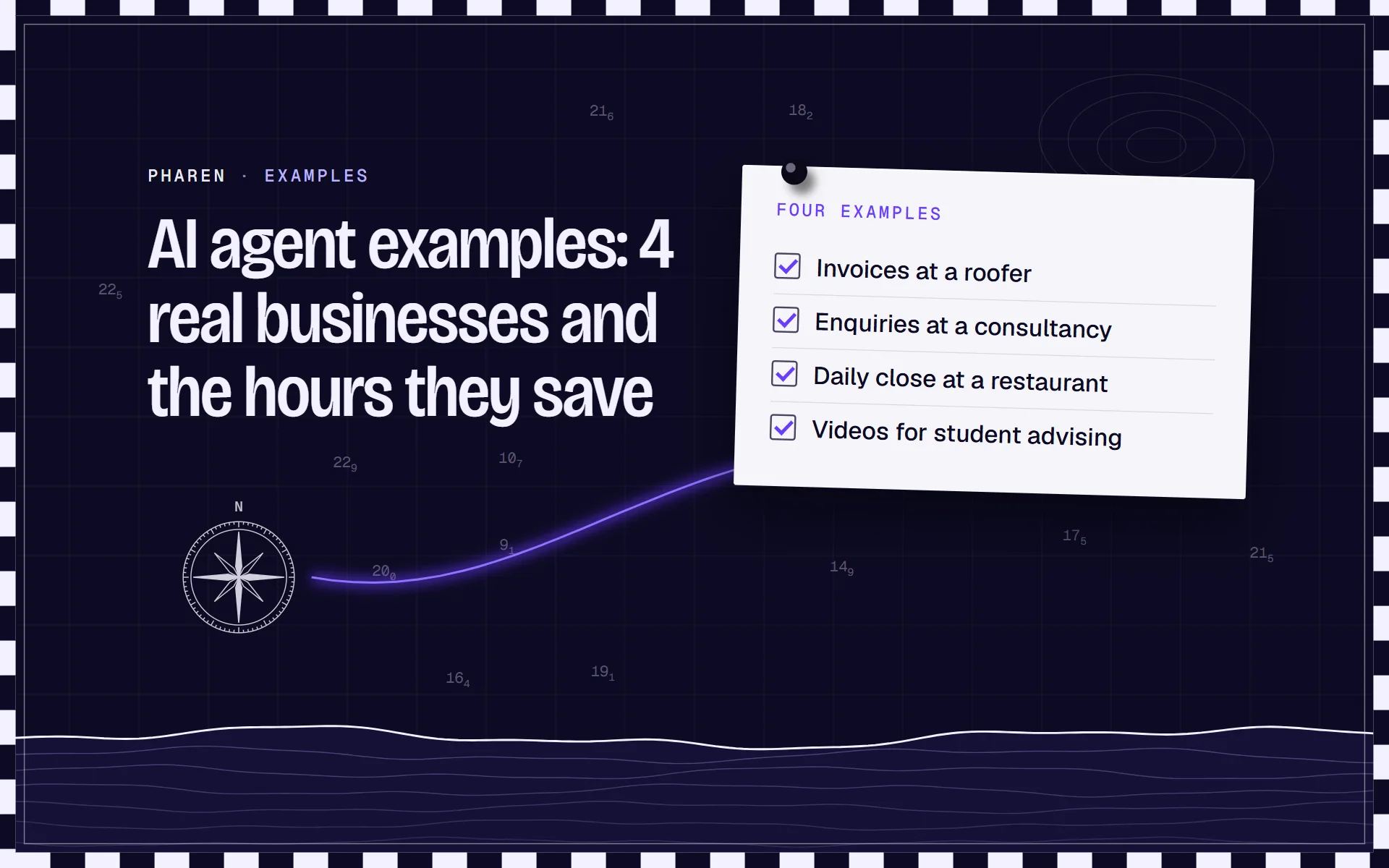
Whether twice the usual salmon comes in for the weekend is still decided by someone who knows the calendar. If the supplier invoices pile up as well, our post on automating incoming invoices shows such an approval process at a roofing company.
Staff rota
A draft rota follows rules: availability, qualifications, rest periods and, for minijobs, the limit of €603 a month. A minijob is a German form of marginal employment with a monthly earnings cap, and at €13.90 an hour that cap works out at about 43 hours a month. Limits like these belong in a fixed rule that warns before the rota is final.
AI can collect swap requests from the group chat and make a suggestion. The shift manager decides who gets which shift, because that depends on agreements that are in no spreadsheet.
Reservations and group enquiries
Your reservation system books single tables, and no agent is needed for that. An agent helps with enquiries by email, such as “Company party on the 12th, about 25 people, two vegan, one with a nut allergy, can you do a set menu up to €45?”
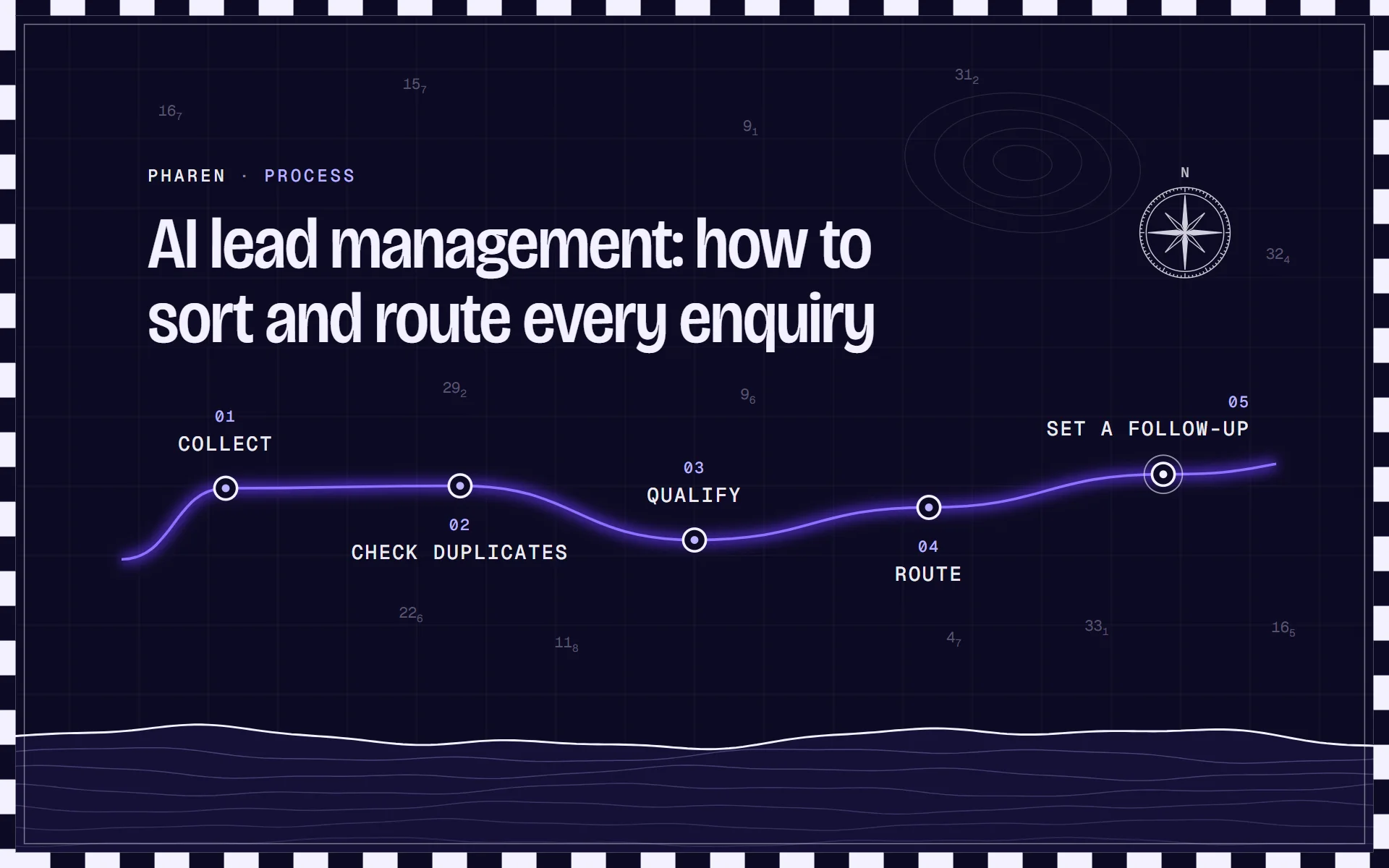
An agent reads an email like this, puts date, number of guests, occasion, budget and allergies into a list and drafts a reply with suitable menus. A person confirms. How to collect and route enquiries like these from several channels is covered in our post on AI lead management.
Replying to reviews
A reply to every review shows guests that someone is listening. After a busy Saturday, nobody writes them anyway. A language model drafts replies in the tone of your restaurant, short for praise and with a concrete reference to what the guest wrote for criticism.
Replies go online after the owner has had a look. AI must not invent anything here: no promises of compensation, no statements about allergens, no blame on a member of staff.
Where do you really need a language model?
In fewer places than the term suggests. This table helps you sort the tasks.
| Task | Language model needed? | What stays with the team |
|---|---|---|
| Daily close | No, fixed rules | Resolving exceptions |
| Reconciling platform payouts | No, only for PDF statements | Disputes with the platform |
| Supplier orders | For supplier emails and delivery notes | Approving the order |
| Staff rota | For swap requests in free text | Assigning shifts |
| Group enquiries | Yes, reading free text and drafting | Confirming the offer |
| Reviews | Yes, reply drafts | Publishing |
If you start with the daily close, you build a workflow without a model first. It costs less to run, gives the same result every evening and everyone on the team can follow what it does. AI comes in where text comes in.
What does the daily close save at BeeBee?
BeeBee in Ilmenau delivers 7 days a week, and delivery hours end at 8 pm. About 3,700 orders come in each month, about 120 on a normal day, at the till, in the online shop and through delivery platforms. All figures are in the BeeBee case study.
Before, someone opened all 3 views every evening, copied the totals into a spreadsheet and checked whether order count, revenue and payout matched. If a cancellation had no reason, the search went back to the shift, often not until the next day. At month end, about 8 more hours went into checking the platform payouts against the orders once again. We calculate with €27.40, the labour cost of an hour worked in hospitality in 2025 according to Destatis.
| Measure | Before | With the workflow |
|---|---|---|
| Evening check | About 60 minutes | About 5 minutes |
| Month end close | About 8 hours | About 1 hour |
| Hours a month | Almost 40 | About 3.5 |
| Items to check in the evening | All of about 120 orders | 0 to 3 on most days |
About 60 minutes on about 30 evenings is 30 hours, and with the month end close almost 40. Today it is about 5 minutes an evening, 2.5 hours in total, plus 1 hour for the month end close. That saves about 35 hours a month, worth about €950 at €27.40 an hour.
The second part comes from the platform statements. On a sample day, 26 September, the overview showed 75 till orders worth €2,520, 30 online shop orders worth €945 and 19 platform orders worth €655, together 124 orders and €4,120. Two items stayed open: one platform payout was €43.10 below the order total, and 2 till cancellations had no reason.
Gaps like these now show up the same evening, while they can still be documented and disputed. At about 10 a month that is about €430. Together with the working time, BeeBee saves about €1,400 a month.
Work it out for your own restaurant
Take the evenings a month times the minutes for the reconciliation, divide by 60, add the hours for the month end close and multiply by €27.40. A worked example with open assumptions: a café with one till and one delivery platform needs 20 minutes an evening on 26 days and 3 hours at month end. That is about 11.7 hours or about €320 a month.
With us, a first agent costs from €1,999 once and support from €199 a month, plus VAT, plus the usage costs. The details are on our implementation page. For the café, little is left after the support fee, and a good export template with a spreadsheet of fixed formulas is often enough.
At BeeBee, with three sources, about 120 orders a day and gaps in the platform payouts, the numbers look different. The number of sources matters more than the size of the restaurant.
How do you get started?
- Choose one process. The one that comes back every evening and annoys you most. For delivery businesses that is almost always the daily close.
- Measure for two weeks. Minutes per evening, hours at month end, open differences and their amount. Without these numbers you will not know later whether it paid off.
- Check the exports. Which data do the till, shop and platforms provide, through an interface or as a file? That decides how much needs to be built.
- Write down the rules. What counts as a discrepancy, from which amount, which fees do not count, which cancellation reasons exist? The person who reconciles in the evening today writes this list.
- Run in parallel. For two weeks the team keeps reconciling by hand and compares its result with the workflow’s overview. Whatever differs gets fixed.
- Add text tasks only then. Once the figures run, group enquiries or reviews follow, with an agent that writes drafts.
To decide which process comes first in your restaurant, our AI opportunity analysis ranks the candidates by effort and benefit. If you want the whole team to use AI safely first, book a training session that works with your own receipts and reviews.
What are the limits, and when should you skip it?
The till stays the leading system. The workflow at BeeBee changes no payout and books nothing in the accounts. It reads, compares and shows where a decision is needed. That separation is deliberate, so what the till records stays untouched and resolving issues stays with the restaurant.
Allergens are no job for probabilities. A language model can phrase a sentence about nuts convincingly and still be wrong. Statements about allergens come only from your checked recipes, never from a draft.
Never publish reviews unchecked. An automatic “Thanks for the great feedback” under a one-star review is worse than no reply at all.
Protect guest and staff data. Reservations contain names, phone numbers and sometimes health information such as allergies, and rotas contain employee data. Decide which data may go into which AI tool and where it is processed. Pharen Hub, for example, runs at Hetzner in Germany or on your own server.
Not every interface provides what you need. Some platforms provide their statements only as a file or with a delay. Then the reconciliation runs the next morning, and if you know this beforehand, you can plan for it.
When to skip it. If you have only one till, no delivery platform and no differences, there is nothing to reconcile, and orders or reviews are the better place to look. If you have no fixed routine for the close yet, set one up by hand first. A workflow automates the routine you have and cannot invent one.
Frequently asked questions about AI in restaurants
How much does AI cost for a restaurant?
With us, a first agent or workflow costs from €1,999 once and support from €199 a month, plus VAT. On top come the running costs for the AI models by usage, which hardly arise for a pure reconciliation of figures. The price depends mainly on the number of connected systems.
Do we need a new till system?
No. The workflow reads the data from the till, online shop and platforms you already have and changes nothing there. What matters is that the systems hand out their data through an interface or an export.
Can AI reply to Google reviews on its own?
It can write drafts in the tone of your restaurant, which someone on the team checks and publishes. We advise against automatic publishing, because a wrong promise or an unsuitable reply stays public.
Is AI worth it for a small restaurant?
That depends less on size than on the number of sources. With a till, an online shop and several delivery platforms, an automated daily close pays off quickly. With one till and one platform, a spreadsheet with fixed formulas is often enough.
Can AI write the staff rota?
It can draft one and sort swap requests. Limits such as the minijob earnings cap of €603 a month belong in fixed rules. Assigning shifts stays with the shift manager.
How long does it take to set up?
A daily close like BeeBee’s needs the exports from all sources, your rules for discrepancies and two weeks of parallel running. How long the build takes before that depends on how the systems hand out their data.
Summary
AI in restaurants pays off first after the kitchen closes, where a workflow brings till, online shop and delivery platforms together, checks them by fixed rules and shows only the exceptions. At BeeBee that means about 5 instead of 60 minutes an evening, about 35 hours and about €1,400 a month. A language model comes in where guests and suppliers write in full sentences. Get in touch and we will go through one evening’s statements with you to see where your close gets stuck.