AI lead management means that every enquiry lands in one shared list, whether it comes through a form, email, LinkedIn or a referral. A workflow checks whether the contact already exists, an agent suggests a category, and a fixed rule gives the enquiry a team and a date to follow up. At a consulting firm with about 800 enquiries a month, the search per enquiry fell from about 8 minutes to about 1, which saves over 90 hours a month.
Enquiries are what a business lives on, yet they rarely sit in one place. Some come through the website, some by email, some by phone, and the best referral sits in the owner’s private inbox. Everyone assumes someone else has already replied.
According to Bitkom, Germany’s digital industry association, 36% of German companies with 20 or more employees used AI in 2025. Of those, 88% used it in customer contact, far ahead of every other area. Sorting enquiries is part of that customer contact, and most of the sorting runs on fixed rules, with AI doing the reading.
What is AI lead management?
A lead is an enquiry from someone who might become a customer. Lead management is everything that happens between that enquiry arriving and the first real conversation: capturing, checking, categorising, assigning and following up. With AI, a language model takes over the reading, such as pulling name and request out of a forwarded email and judging whether someone needs a first meeting or documents first.
Three things are often confused with it. A CRM stores contacts and conversations but sorts nothing by itself. Lead scoring awards points for clicks and downloads and is more of a marketing tool. A chatbot on the website answers questions but does not decide who on the team is responsible.
AI lead management sits in front of all three and makes sure every enquiry has an owner before it disappears into the CRM. AI is the smaller part of it. The larger part is rules that run without any model.
Signs that enquiries are slipping through
Many businesses believe they have no problem with enquiries without having a figure to check it against. These four signs suggest that enquiries are being left lying.
- Nobody can say how many enquiries came in last month.
- The same person gets contacted twice. Once by sales and once by management, because the enquiry sat in two inboxes.
- The first reply takes longer than one working day. In our consulting example it often took 2 days.
- Following up depends on memory. In the same example, one in 5 enquiries never got a second message.
If more than one applies, count enquiries per channel for a week. Our AI opportunity analysis turns a count like this into a list of processes ranked by effort and benefit.
What are the five stations of an enquiry?
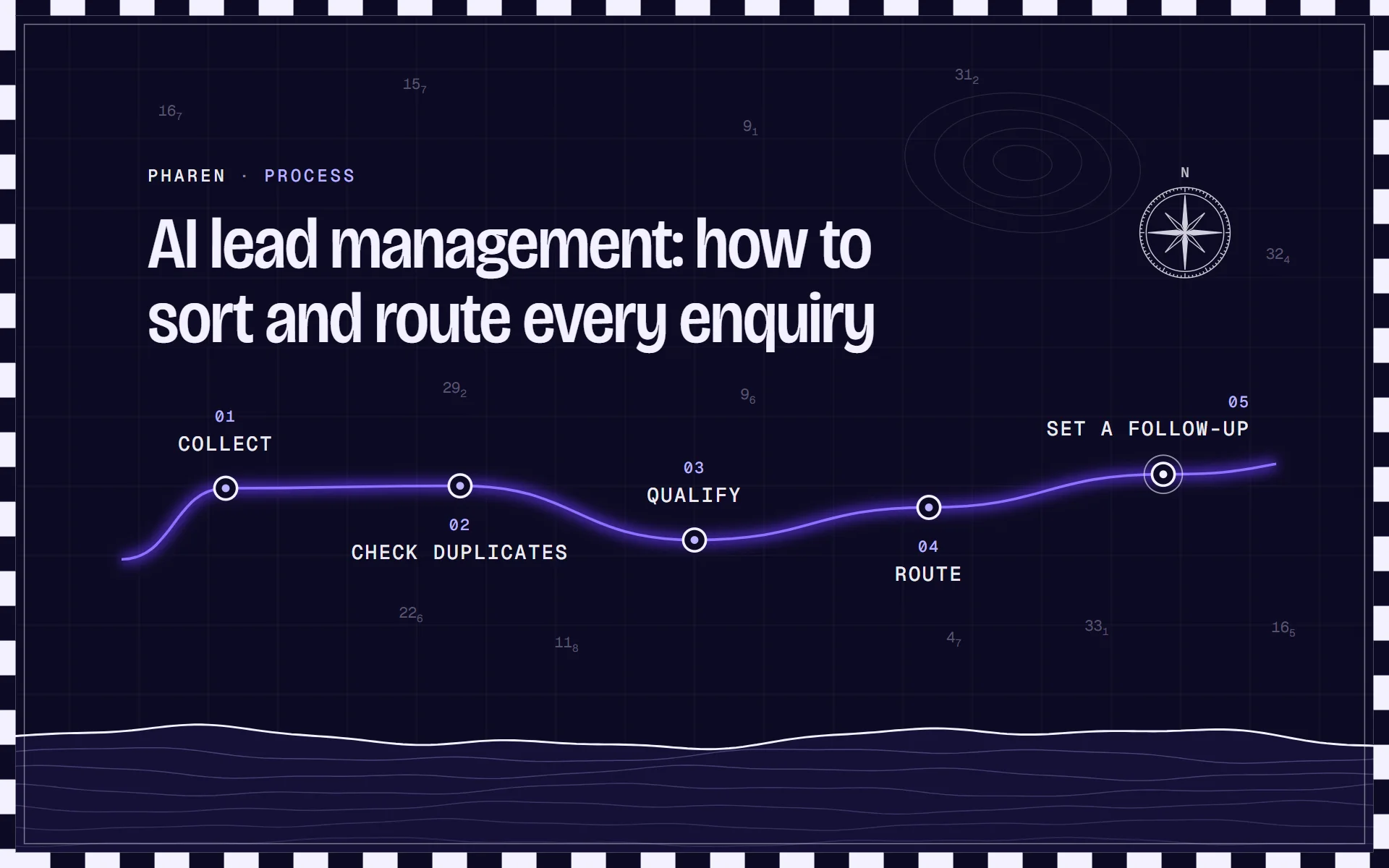
Every enquiry passes through the same five stations, whether you roof houses, sell courses or advise companies. At each station the question is whether it needs a language model or whether a rule is enough.
1. Collect every channel
First, every enquiry goes to one place. The workflow enters website forms by itself, and that needs no AI. Referrals, phone calls and LinkedIn messages get a short manual entry in the same list.
Forwarded emails are different, because the name is in the signature, the region in the third paragraph and the request somewhere in between. An agent reads the email and fills in the fields.
2. Check duplicates
Before anyone replies, the workflow checks whether the person is already known, by email address, company name and phone number. If a conversation is already running, the new enquiry goes to the existing contact as a note, so nobody writes to the same person twice. This check is a plain comparison. A model helps at most with messy spellings such as “Müller GmbH” and “Mueller Gesellschaft mbH”.
3. Qualify the enquiry
This is where AI does most of its work. It reads the enquiry and suggests a category. In the consulting example there are three routes: first meeting, documents first, or follow up later. The category is a suggestion with a short reason, and the responsible person can change it with one click.
4. Route to a team
A fixed rule handles the assignment, without AI. In the example, the region decides between Team North, East, South and West. In a trades business it could be the trade, in a school the course, in retail the order size. Everyone on the team can trace a rule, and it gives the same result every time.
5. Set a follow-up date
Every enquiry gets a status and a date on which the team gets back in touch. Every working day at 8 am, the workflow looks for enquiries whose date has come and that are still open, and reminds the responsible person. It sends no message to the customer, because that stays with people.
| Station | Who does it | Is AI needed? | Typical mistake |
|---|---|---|---|
| Collect | Workflow, agent for emails | Only for free text | A channel gets forgotten |
| Check duplicates | Workflow | Rarely | Matching by email address only |
| Qualify | Agent, as a suggestion | Yes | Too many categories |
| Route | Fixed rule | No | AI decides who is responsible |
| Follow up | Workflow reminds, person writes | No | A status but no date |
Which criteria does the AI sort by?
You set the criteria and the AI applies them. The consulting example uses three: need, relevance (does the enquiry fit what you offer?) and timing (when does the person want to start?). More than three criteria or more than four outcomes make the categories harder to check.
This is how it looks in different sectors.
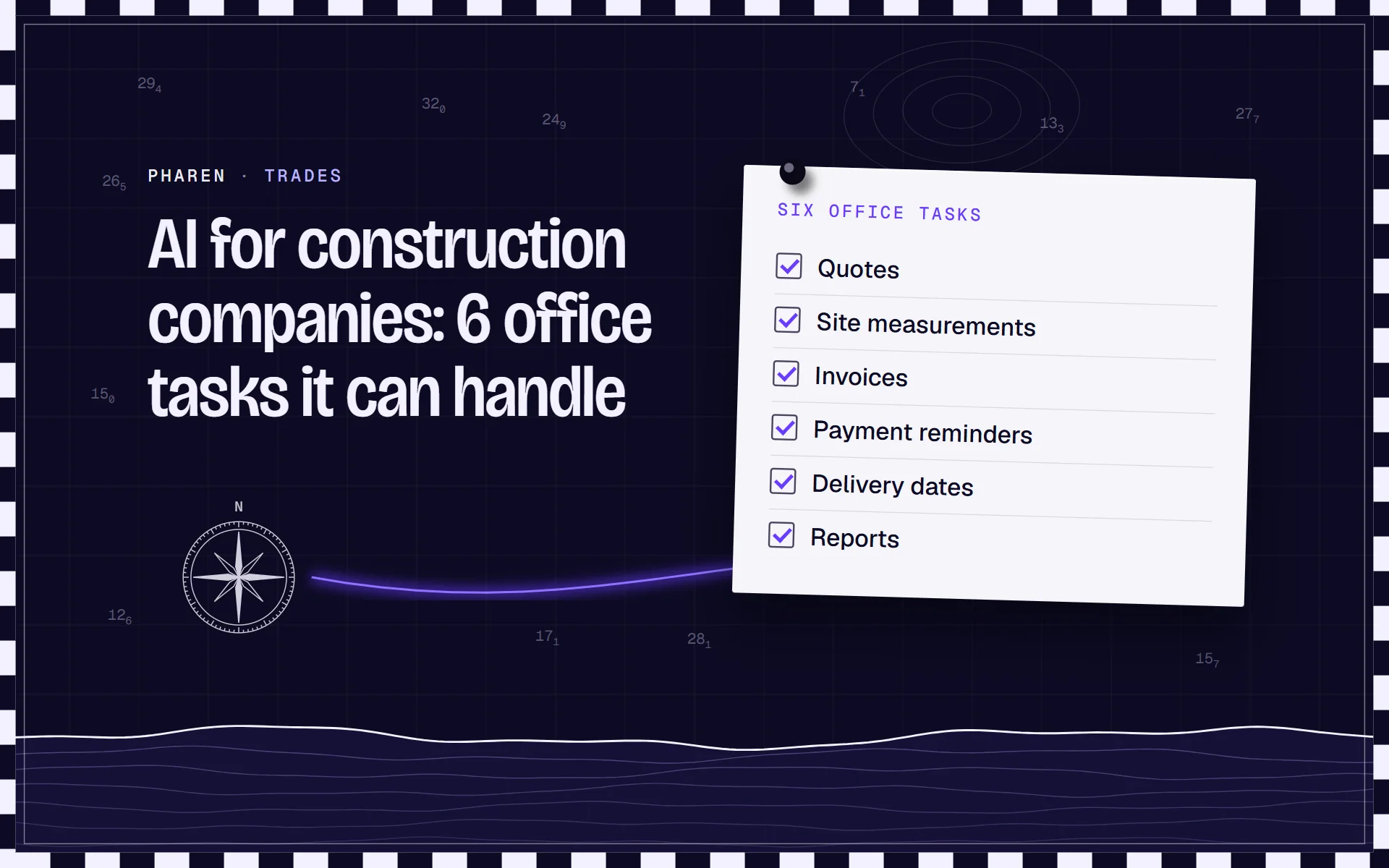
- Skilled trades. “Roof renovation, detached house in Grimma, start in spring” gets a first meeting with a site visit. “Roughly what does a new roof cost?” first gets a price range and references. What happens to the quote afterwards is covered in our post on AI for construction companies.
- Education. Someone asking about a course date gets the next dates, and an enquiry for a whole team goes to the person for corporate customers.
Write the criteria down as a short instruction with two or three real examples from your inbox. Allow it to answer “unclear”, because an honest gap is better than a guessed category.
What does it save with 800 enquiries a month?
The consulting firm from our lead routing case study receives about 800 enquiries a month, almost 40 on a normal working day. They come through the website form, by email, as referrals, via LinkedIn and from conversations. Before any reply came the search: does the person already exist, has someone replied, who is responsible? The calculation uses €45.00, the average cost of an hour of work in Germany in 2025 according to the Federal Statistical Office (Destatis).
| Measure | Before | With the workflow |
|---|---|---|
| Search per enquiry | About 8 minutes | About 1 minute |
| Search per month | Over 100 hours | About 13 hours |
| Cost of the search per month | About €4,800 | About €600 |
| First reply | Often after 2 days | Usually the same day |
| Enquiries without follow-up | About 160 | 0, each has a date |
800 enquiries times 8 minutes is 6,400 minutes, over 100 hours. After that, about 1 minute per enquiry remains for a look at category and team, about 13 hours in total. The difference of over 90 hours is more than 2 working weeks, about €4,200 a month at €45.00 an hour.
The roughly 160 enquiries a month that used to get no second message are not in that calculation. Today each has a team and a date. How many turn into orders depends on the offer and the conversation, so the firm tracks time to first reply, enquiries without a team and overdue follow-up dates.
And for a smaller business?
Use the same formula with your own figures: enquiries a month times minutes of searching, divided by 60, times your hourly rate. A worked example with open assumptions: a trades business receives 150 enquiries a month and spends 6 minutes searching per enquiry. That is 15 hours, about €590 at €39.60 labour cost per hour in construction (same source). If the search drops to 1 minute, 2.5 hours remain, and about 12.5 hours or about €495 a month are saved.
On our side, that compares with a first agent from €1,999 once and support from €199 a month, plus VAT, plus the AI usage costs. With about €300 a month left before AI costs, the build pays for itself in a little over six months, without a single extra order.
How do you set it up in seven steps?
The build does not take months if you go in this order.
- List the channels. Every way enquiries come in, including the awkward ones: phone, trade fairs, referrals, the boss’s private mobile.
- Count for a week. Enquiries per channel, minutes until assignment, enquiries without a reply after 48 hours. That is your baseline.
- Create a list. Fields for name, source, request, category, team, status and follow-up date.
- Write responsibility as a rule. Region, trade, product or amount. If you cannot state the rule in one sentence, you do not have one yet.
- Set the criteria for categories. Three questions, three to four outcomes, two real examples per outcome.
- Run in parallel for two weeks. The agent suggests, and the team decides as before and corrects. Every correction shows where the instruction needs sharpening.
- Measure and adjust. Check time to first reply, share of corrected categories and overdue dates every month.
As part of implementation, we work out with you where an agent works in the list and where your existing programs stay. If you have no shared list yet, Pharen Hub comes in.
What does GDPR mean for lead management?
Enquiries contain personal data, so the GDPR applies, and two points deserve attention. This reflects our understanding as of November 2026 and is no substitute for legal advice.
No decision by the machine alone. Article 22 GDPR gives people the right not to be subject to a decision based solely on automated processing that produces legal effects concerning them or similarly significantly affects them. A business enquiry rarely reaches that threshold. We still keep the category a suggestion, and no workflow turns anyone down on its own.
Following up is no advertising campaign. Replying to an enquiry is fine, while automated email sequences with advertising are a different matter. Under Section 7 of the German Act against Unfair Competition (UWG), advertising by email without the addressee’s prior express consent counts as an unacceptable nuisance, with a narrow exception for existing customers. That is why the workflow in the example only reminds the team, and a person writes the message.
Then there is the usual groundwork: a data processing agreement with the provider of the AI model, a clear rule on which data may go into which tool, and deletion periods for enquiries that lead nowhere. Settle this with your data protection officer before the first real enquiries run through.
What are the limits, and when should you skip it?
The AI is sometimes wrong. A short enquiry like “Please call me back” cannot be categorised in any useful way, and a brief email from a large corporation can look like a private enquiry. That is why every category comes with a reason, and the team corrects it. If the team corrects more than one in five categories, the criteria need work.
A category is no judgement about people. Turning a three-line enquiry into a “bad lead” throws conversations away. An agent may sort who gets called first. Whether someone gets no call at all is decided by a person.
Too much at once. Five channels, seven categories, automatic replies and a new CRM in one step rarely work. Start with the list, the rule and the date, and add AI once the list runs.
When to skip it. With fewer than 50 enquiries a month and a team in one room, a shared list with status and date is often enough, with no AI at all. If enquiries come almost only through a form with fixed fields, a rule in the form is enough. An agent pays off when a lot of free text comes in from several channels and the search takes hours every month. Our post on automating incoming invoices applies the same pattern to invoices.
Frequently asked questions about AI lead management
How much does AI lead management cost?
With us, the first agent costs from €1,999 once and support from €199 a month, plus VAT. On top come the costs for the AI model by usage. The price depends mainly on the number of channels and programs to connect.
Do we need a new CRM?
No. The workflow can hand enquiries over to your existing CRM after it has matched, categorised and assigned them. If you do not have a CRM yet, a shared list with status and date is enough to start.
Can AI reply to enquiries automatically?
Technically yes, but we advise against it for the first reply. An automatic acknowledgement of receipt is unproblematic, and with us a person writes the actual answer. Advertising email sequences without consent are risky under Section 7 UWG anyway.
Is AI lead management worth it for small businesses?
From about 100 enquiries a month across several channels, it usually pays off through the saved search time alone. Below that, start with a shared list and a rule for who is responsible. AI comes in once free text and channels increase.
How long does the setup take?
The list and the rules are usually in place within a few days, followed by two weeks of parallel running with real enquiries. The rest depends on how many channels are connected and how clean your data is today.
Summary
AI lead management needs less technology than its name suggests: a list where every enquiry lands, a rule that gives it an owner, a follow-up date and an agent that does the reading. In the consulting example that saves over 90 hours of searching a month, and the first reply usually goes out the same day instead of after 2 days. Start by counting your enquiries for a week. Get in touch with that count, and we will go through the numbers with you.