


On busy days, BeeBee handles more than one hundred orders across the POS, online shop and delivery portals. At daily close, the figures were spread across three separate systems.
Every order was recorded, but there was no single overview. The day was complete only after someone put orders, revenue, cancellations and settlements side by side.
Before: about 30 minutes after service
The POS showed counter sales, the shop held direct online orders, and each delivery portal had its own orders and settlement. The figures did not arrive in the same format or use the same labels.
A team member opened all three views, copied the daily totals and checked whether order values matched the settlements. Every cancellation needed a reason. If it was missing, the search went back to the shift. If a portal settlement was lower than its orders, someone had to determine whether the difference came from a fee, a delayed payment or an error.
The reconciliation usually took about 30 minutes. After a full day, that was the wrong time for three exports and mental arithmetic.
What we built in Pharen Hub
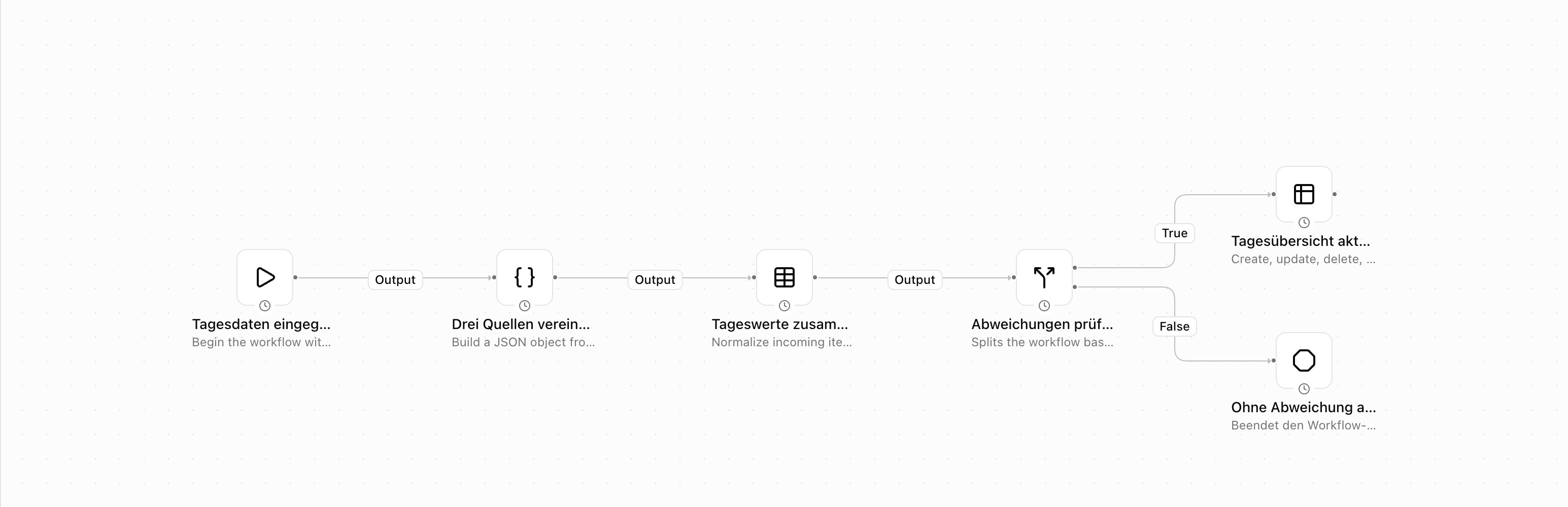
We built daily close as one workflow. It takes the daily data from the POS, online shop and delivery portals, maps them to the same fields and writes orders, revenue and cancellations to one overview.
The workflow then applies fixed checks: do order and settlement values match, and does every cancellation have a reason? Anything unresolved appears as an open item. A day without a discrepancy closes without the team checking every total again by hand.
How daily close works today
- After service, the daily totals from the POS, online shop and delivery portals enter the workflow.
- The workflow maps their different fields to one shared structure.
- Orders, revenue and cancellations are added by source and stored as the daily total.
- Settlements and cancellation reasons pass through the agreed checks.
- With no discrepancy, the day receives the status “Complete”. With a discrepancy, only the affected item stays open.
- The team checks the receipt or shift note, adds the reason and closes the item.
The workflow does not alter a settlement or post anything to the accounts. It prepares the reconciliation and shows where a decision is needed. BeeBee remains responsible for resolving it.
One day, two open items
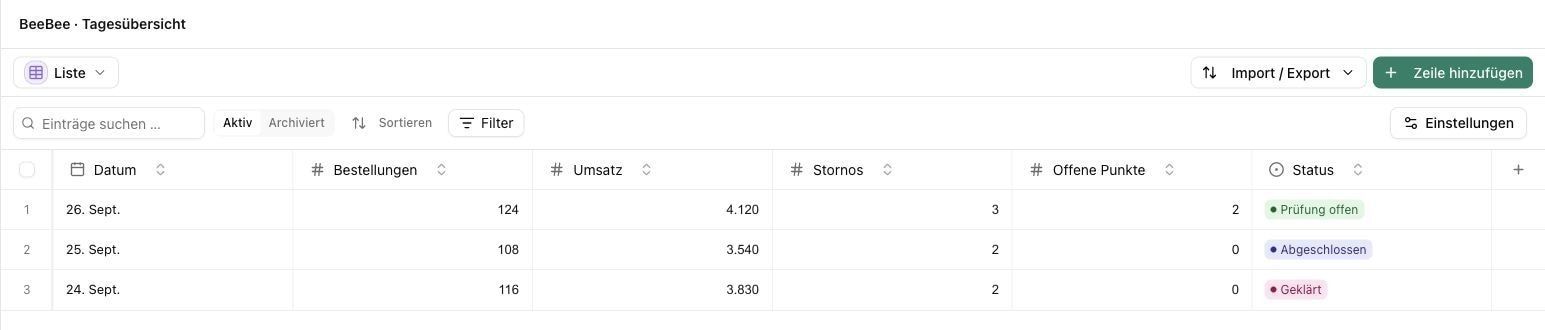
For the view shown here, we anonymised one operating day: 75 POS orders worth €2,520.00, 30 online shop orders worth €945.00 and 19 delivery portal orders worth €655.00. Together, that is 124 orders and €4,120.00.
Three orders were cancelled. Two items remained for the team: one delivery settlement was €43.10 below the order value, and two POS cancellations had no reason. Everything else had already been reconciled.
What changed
Daily close no longer starts with three screens and an empty spreadsheet. The team opens the daily overview and can immediately see whether anything needs attention. Copying totals, adding sources and rechecking uneventful days have disappeared.
The review now takes only a few minutes. On most days, zero to three exceptions remain. Time goes into the two questions that actually need an answer: why does a settlement differ, and what caused a cancellation?
Daily operations run in the restaurant. The back office runs in Pharen.
