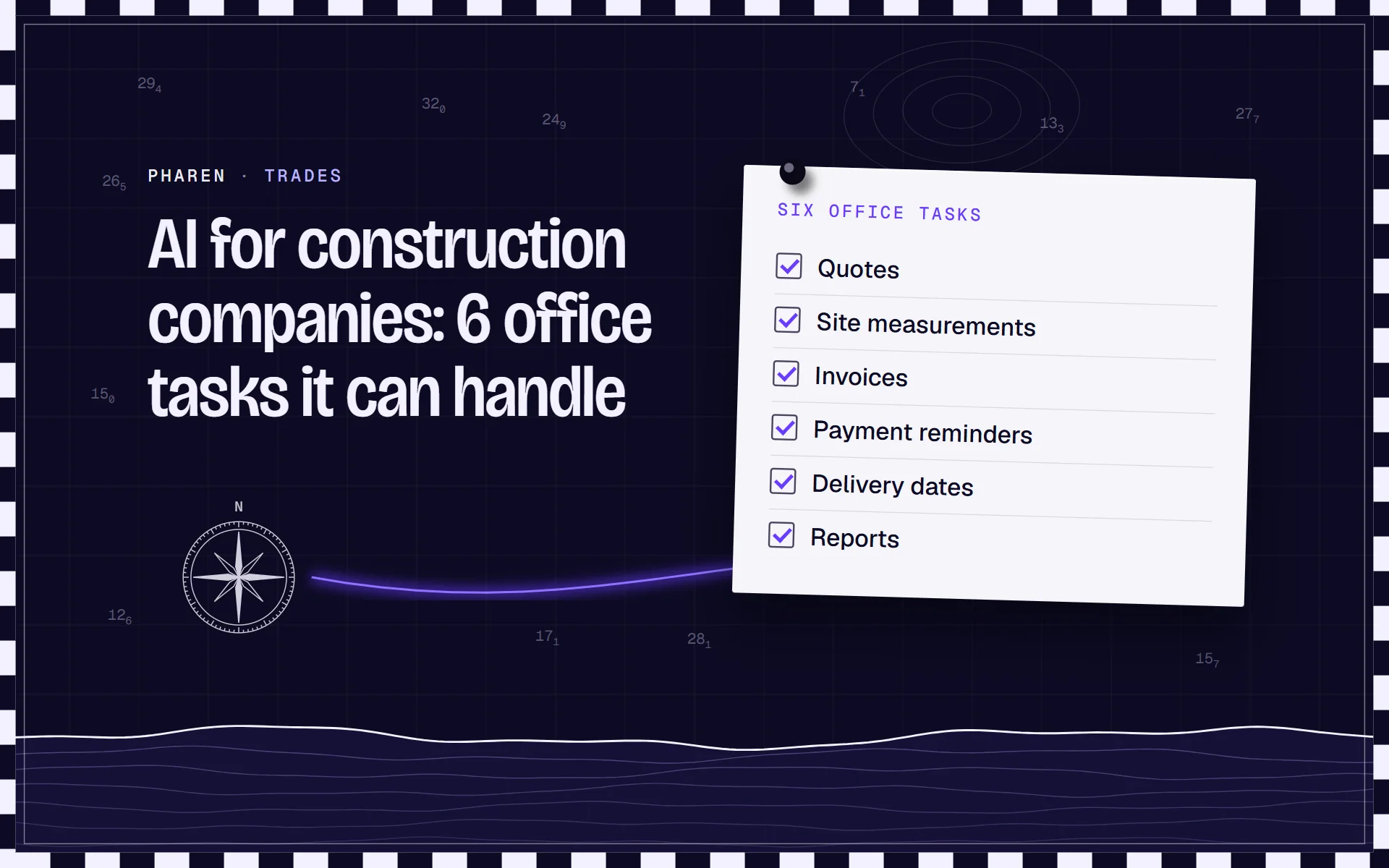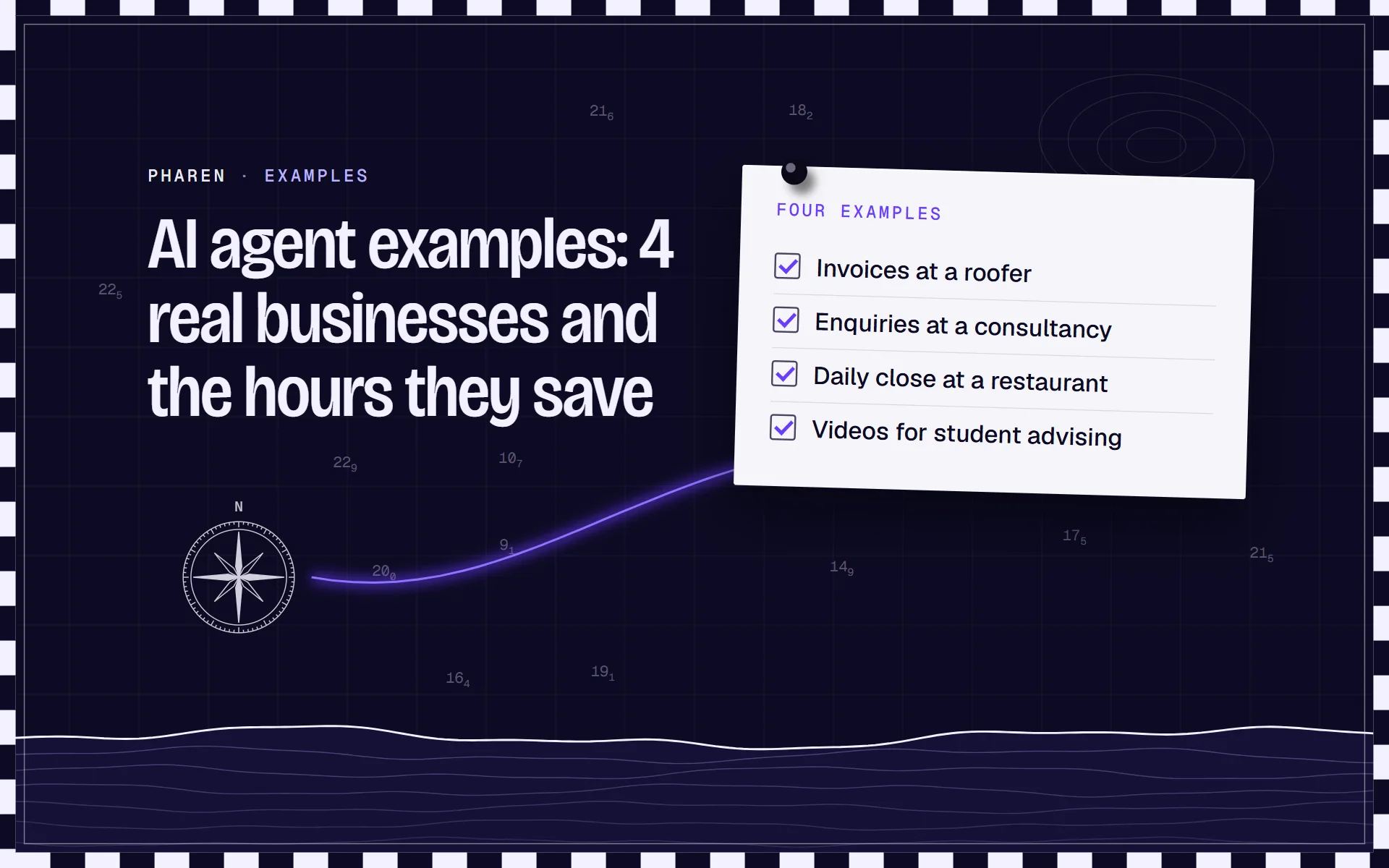
Good AI agent examples from small and mid-sized businesses sound like office work. An agent reads invoices at a roofing firm, sorts enquiries at a consulting firm, reconciles the till at a restaurant every evening or prepares videos for a study abroad consultancy. In the four German businesses below, that saves between 12 and over 90 hours a month, and in every case a person approves at the end.
Many companies are still looking for examples like these. According to Bitkom (in German), Germany’s digital industry association, 57% of companies with 20 or more employees used AI in September 2026, up from 36% a year earlier. Of the companies that use, plan or discuss AI, 11% already use AI agents and 29% plan to. Among companies without AI, 30% say they lack use cases.
The four use cases below come with figures from our case studies, what the agent does and the point where it stops.
What is an AI agent in a business?
An AI agent works through a task over several steps on its own. It fetches data, reads invoices, emails or exports, applies rules, passes results to other programs and flags when it is unsure. A chat window, by contrast, answers only the question it is asked and then waits for the next one.
In daily work, an agent sits inside a workflow that decides what it may do and where it stops. Every step is part of the workflow, and every decision stays with the case, so you can check what the agent did. Our guide on how to build an AI agent explains the build step by step. The four businesses below show where agents already run and what they bring.
What do AI agent examples from real businesses look like?
The four examples come from a craft business, a consulting firm, a restaurant and an education business. For each one, you see how the workflow ran before, what the agent takes on today, where a person decides and what the result is.
Craft business: incoming invoices at a roofing firm
The roofing firm Hobeck in Belgern, Saxony, receives around 160 invoices a month. Before, every invoice was typed in, matched to a job site and passed on for approval, about 5 minutes each. Approval often took more than 7 days, and some early payment discounts (Skonto, common with German suppliers) expired along the way.
Today an agent team reads every invoice, fills in 8 fields from supplier to cost centre and suggests the job site. Validation rules hold back missing required details and uncertain values, along with around 4 possible duplicates a month. Above a set amount, management approves, and only then does the invoice go to DATEV, the German accounting software. Bookkeeping and payment are still done by hand.
An invoice now takes under 30 seconds, and approval takes 1 to 2 days. The Hobeck case study shows the whole workflow.
Consulting: sorting and routing enquiries
A consulting firm receives around 800 enquiries a month through five channels: the website form, email, referrals, LinkedIn and conversations. Before, someone spent about 8 minutes per enquiry finding out who the person was, what they wanted and who was responsible. About one in five enquiries never got a follow-up, around 160 a month.
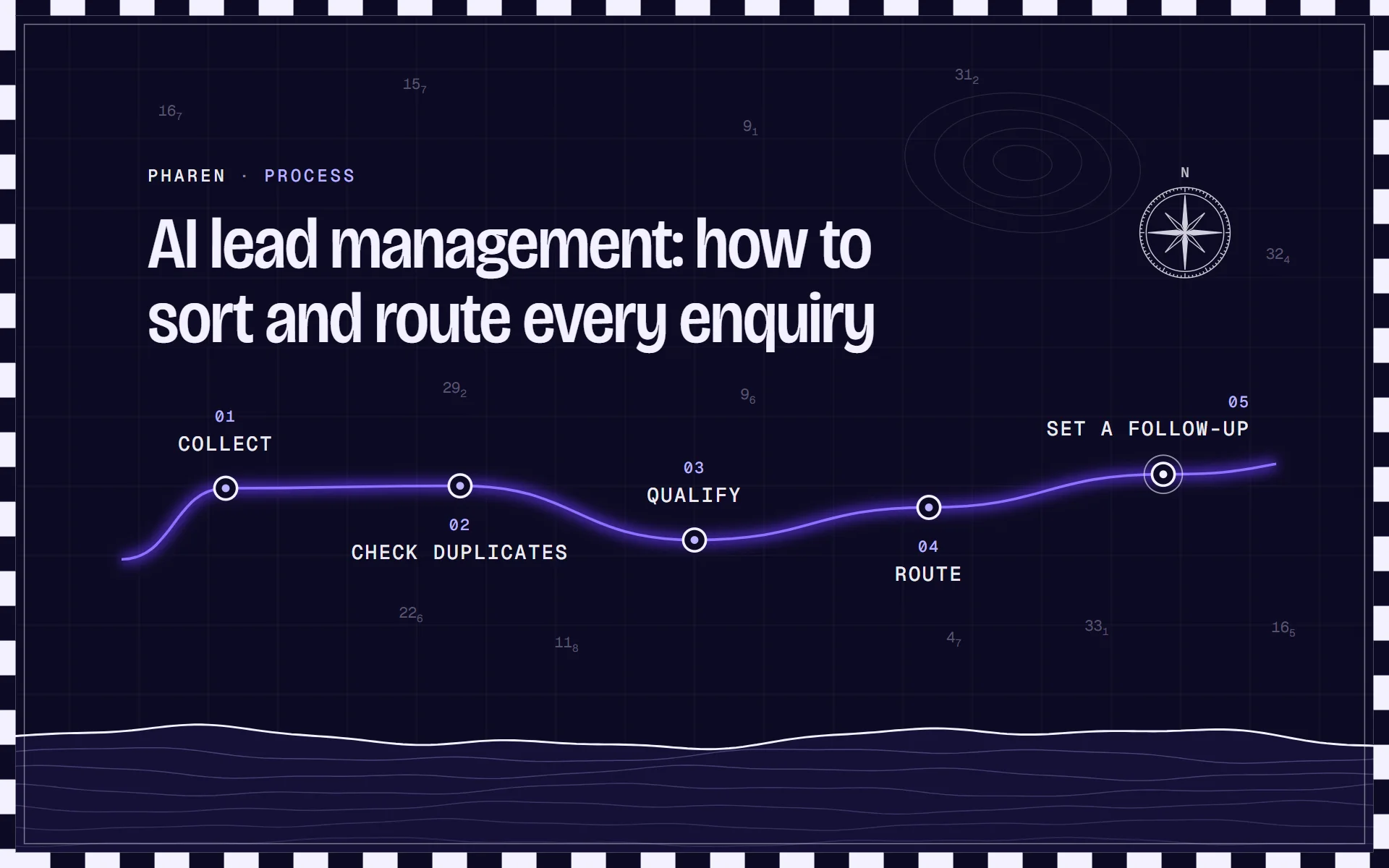
Today the workflow first checks whether the contact already exists. An agent then sorts new enquiries by need, relevance and timing, a rule hands them to the team for the right region, and every enquiry gets a follow-up date. Every working day at 8 a.m., the Hub shows which follow-ups are due. The workflow sends nobody a message, the sorting is a suggestion, and the team holds the conversations.
The search dropped from about 8 minutes to about 1 per enquiry. That is over 90 hours a month, around €4,200 at €45.00 per hour. The first reply now usually goes out the same day, where it often took 2 days before. The lead generation case study has the details.
Restaurant: the daily close
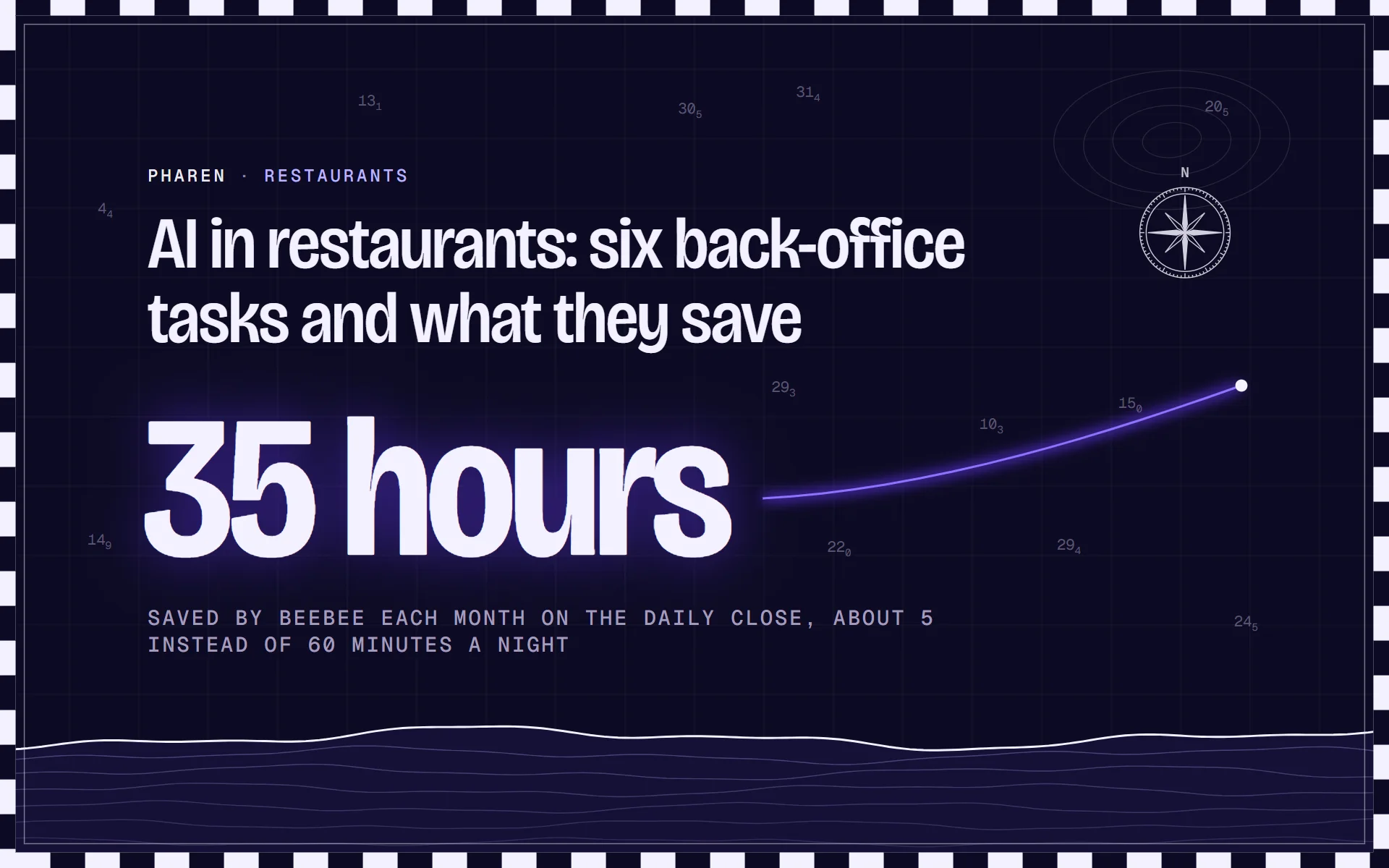
The restaurant BeeBee in Ilmenau, Thuringia, sells through its till, online shop and delivery platforms, about 3,700 orders a month or around 120 a day. Every evening, someone spent about 60 minutes laying lists from three sources side by side, and the month end close took another 8 hours.
Today the workflow maps the data to the same fields and checks delivery platform payouts and cancellation reasons against fixed rules. On most days, 0 to 3 exceptions remain. On one sample day there were 124 orders worth €4,120, and a gap of €43.10 showed up at once. The reconciliation takes about 5 minutes, the month end close about 1 hour.
This example runs mainly on a workflow with fixed rules and hardly needs a language model. Not every step needs AI, and this example shows it. The figures are in the restaurant daily close case study.
Education: preparing videos at a study abroad consultancy
Jagrati Abroad supports Indian students who want to study in Germany and plans 30 videos a month. Before, the preparation for each video took about 2 hours: finding a topic, writing a script, checking claims, drawing up a shot list.
Today 3 agents share the work. One looks for topics, one writes scripts, and one checks every claim before the shoot. The workflow “Idea to Shoot Pack” creates a shoot pack with script, shot list and caption in 23 seconds. In a test, the review agent received a draft with 3 unsupported claims, among them a guaranteed admission and an unconfirmed free consultation, and found all 3.
Preparation fell to about 20 minutes per video, from 60 to about 10 hours a month. At €45.00 per hour, that is around €2,250. Filming and publishing are still done by hand, as the Jagrati Abroad case study describes.
How do the four examples compare?
Side by side, the four cases show how different an agent can look and how similar the pattern is:
| Business | What the agent does | Who decides | Saving per month |
|---|---|---|---|
| Roofing firm Hobeck | reads invoices, suggests the job site | management above a set amount | about 12 hours plus early payment discounts |
| Consulting firm | sorts and routes enquiries | the team for the region | over 90 hours |
| Restaurant BeeBee | reconciles till and platforms by rules | whoever closes in the evening | about 35 hours |
| Jagrati Abroad | prepares topics, scripts and claim checks | the team before the shoot | about 50 hours |
All four have a fixed trigger, a clear handover and a person at the end. The biggest time savings come where many similar cases pile up. Faster handling pays most where money was lost before, as with the expired discounts at Hobeck.
What does an agent bring in?
Time is only one part of the calculation. At Hobeck, the 12 hours a month are worth around €475 at €39.60 per hour, the 2025 labour cost per hour worked in construction according to Germany’s Federal Statistical Office (Destatis, in German). Because invoices are approved faster, around €1,000 a month in early payment discounts come on top, 2% on around €50,000. Together that is around €1,500 a month.
BeeBee looks similar. The roughly 35 hours saved are worth around €950 at €27.40 per hour in hospitality. On top come around €430 a month from gaps in delivery platform payouts that now show up, about 10 a month. Together that is around €1,400.
For your own workflow, the calculation works like this, here with openly stated assumptions for an education provider: 120 registrations a month, 10 minutes each today for typing, checking and preparing the confirmation, and 2 minutes with an agent for the check. That is 16 hours less. At €45.00, the average across all industries according to Destatis, that comes to around €720 a month before support and AI costs.
How do you spot a good candidate?
The four examples pass the same check. Test your own workflow in this order:
- It happens often. 160 invoices, 800 enquiries, 30 evenings, 30 videos a month. Something that happens twice a year does not justify an agent.
- Messy data, clear rules. An agent reads PDFs, emails and exports in other people’s formats well. What should happen afterwards must be something a person in your business can say in one sentence.
- Errors can be caught. At Hobeck a person approves before payment, at Jagrati Abroad filming starts only after the check. Where an error reaches the customer immediately, start somewhere else.
- Minutes can be counted. Without a baseline there is no proof. Cases per month times minutes per case, divided by 60, times the hourly rate.
- Someone knows the process. At Hobeck, the team sat at the table when we mapped the workflow, from the inbox to the bank transfer. Without that person, nobody builds the right agent.
If point 4 leaves you with less than a few hours a month, you probably do not need an agent. We will tell you so.
What does an AI agent cost?
With us, a first AI agent starts at €1,999 one-off and support at €199 a month, both plus VAT. On top come the AI model costs, billed by usage. If the agent runs in Pharen Hub, we add 20% to the actual AI costs, plus the Hub plan.
What drives the price can be said in advance: how many programs the agent has to connect and how clean your data is today. Put the price next to the calculation above, and you can see whether an agent pays off for you. Our implementation page describes how we build and hand over. What a whole automated workflow costs beyond a single agent is covered in our post on AI process automation.
Where do AI agents reach their limits?
The four examples work because someone decided beforehand what the agent may not do. On its page on AI agents (in German), Germany’s Federal Office for Information Security (BSI) warns that an agent may carry out commands hidden in websites, documents or emails as if they were real instructions. It advises giving an agent only the access its task needs and running important actions only after confirmation.
That leads to the typical mistakes we see in projects:
- Too many permissions. An agent that reads invoices from outside senders must not transfer money. At Hobeck, a person still pays.
- AI where a rule is enough. BeeBee hardly needs a language model for its reconciliation. Using AI there costs more and gives less reliable results.
- Nobody responsible. Without a person who reads the run log and resolves exceptions, cases pile up just as they did before.
- Customer contact without approval. In the lead routing, the workflow deliberately writes to nobody. If an agent talks to customers itself, the transparency duties of the EU AI Act have also applied since 2 August 2026.
An agent also does not fix a poor process. If an invoice for €80 needs three approvals today, an agent gives you three faster approvals. Remove the detour first, then build the agent.
Frequently asked questions about AI agent examples
Which tasks do AI agents typically take on in small and mid-sized businesses?
Mostly the preparation in recurring workflows: reading documents, sorting enquiries, reconciling data from several sources and preparing drafts. In our four examples, these are incoming invoices, enquiries, the daily close and video scripts. Decisions with consequences stay with people.
How much time does an AI agent save?
In our examples, between about 12 and over 90 hours a month. What matters is the number of cases and the minutes per case today. Calculate it beforehand: cases times minutes saved, divided by 60, times the hourly rate.
Does every workflow need an AI agent?
No. Where the rules are fixed and the data arrives clean, a workflow with fixed rules is enough, as with the daily close at BeeBee. An agent pays off where someone has to read and sort messy input.
Are AI agents safe enough for invoices and customer data?
With clear limits, yes. The BSI recommends giving agents only the access they need and running important actions only after confirmation. In our examples, no agent books, pays or writes to anyone without a person.
Where should we start?
With a workflow that happens often, whose minutes you can count and where an error can be caught. Check it against the five points above. If a candidate remains, that is your first agent.
Summary
In four businesses, a roofing firm saves around €1,500 a month on incoming invoices, a consulting firm over 90 hours on sorting enquiries, a restaurant about 35 hours on the daily close and a study abroad consultancy about 50 hours on preparing videos. They share many similar cases, clear rules and a person who decides at the end.
The best test is your own workflow. Bring one whose cases and minutes you can count, and get in touch.