

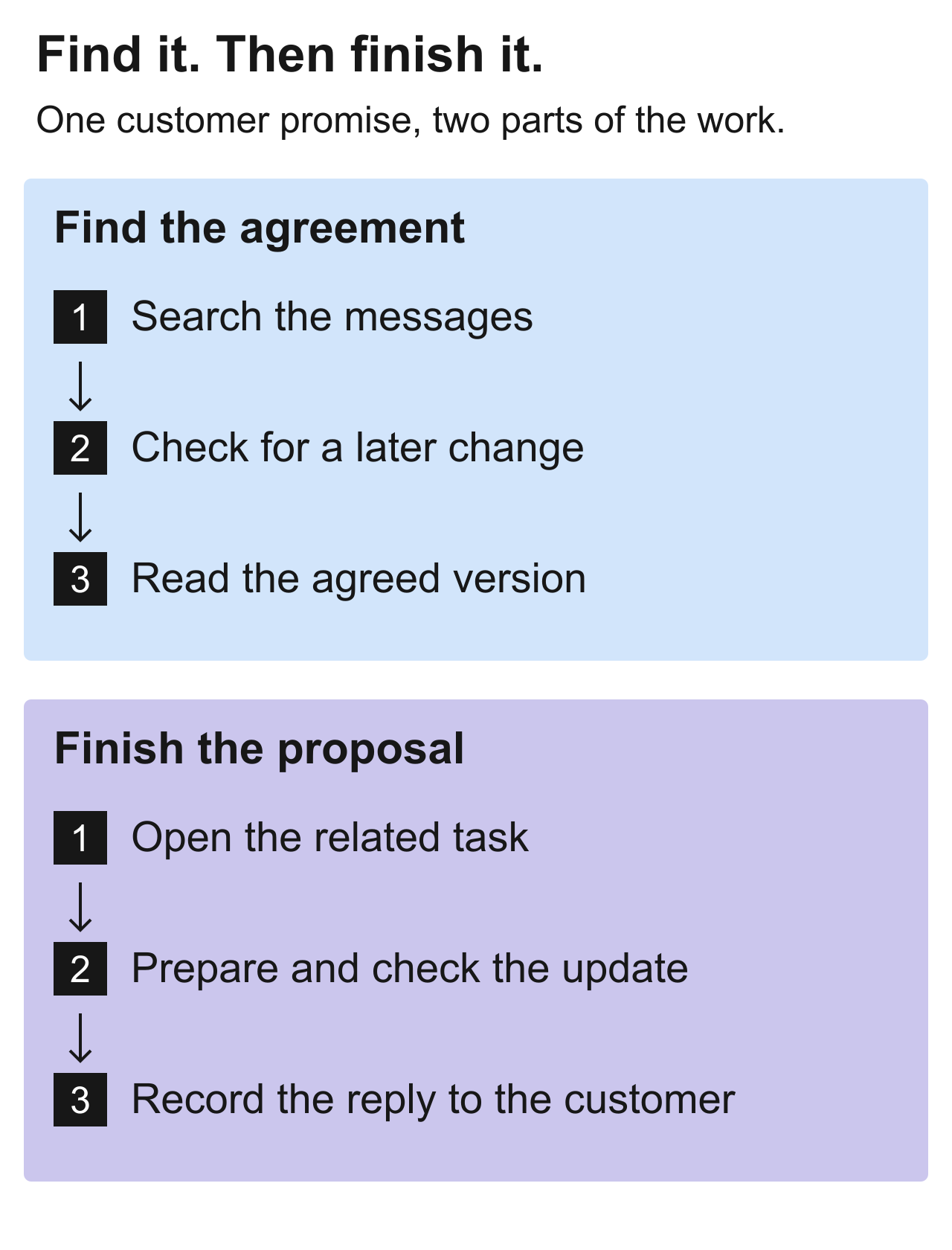
“We promised the customer a revised proposal.” Search finds the message. The promise is clear. The proposal still has not been sent.
This small example contains two different problems: finding an agreement and finishing the work it creates. If you are considering an Onyx alternative, work out which one is slowing your team down.
Onyx connects enterprise knowledge and offers agents and actions. A useful comparison follows the complete promise, including what happens after the answer is found.
Sometimes a sourced answer is the whole job
A support team looking for the current procedure needs an answer it can check. Once it has that, work can continue in the existing ticket system.
Moving every procedure, ticket and discussion into a new workspace might be unnecessary. It introduces decisions about migration, current versions and old links. Search across existing tools can be valuable precisely because it avoids that change.
In a trial, use questions whose answers you know. Include a current and an outdated source about the same subject. Also test a document that one user should not be allowed to access. The result matters when it comes from appropriate sources and can be checked, not merely when it sounds convincing.
Other answers are the beginning of the work
A customer commitment may require more than retrieval. Someone needs to own a task, confirm a date and approve a change. If your current systems handle that well, search can feed into them.
If those relationships are missing, you also have an organisational problem. Another search interface can reveal where information lives. It does not establish who is responsible for acting on it.
Test that connection directly: how does the found answer become a task, where is it maintained and what happens when someone raises a question?
A workspace asks for a different commitment
A shared workspace changes where the team maintains the work.
A team has to be willing to move or deliberately connect work there. That is a real commitment. People need to know which place represents the current state. If a better-maintained version continues elsewhere, the workspace becomes another source of confusion.
A team happy with its tools and mainly struggling to find knowledge should therefore test search across those sources first. A team already planning to reorganise tasks and handoffs has a different reason to consider a workspace.
Compare the whole customer commitment
Use the promise from the opening in both approaches. Ask the same question and inspect its source. Include an outdated statement and see whether the distinction is clear.
Then continue. Can the responsible person take over, work on the resulting task and record a change in a way a colleague can follow? That second part reveals the effort of connecting retrieval to action.
Review licensing, operation and ongoing cost separately. Use the current terms from Onyx and Pharen, including model usage and maintenance. A per-user price and a workspace price are only comparable when they cover the same work.
Where the found promise goes in Pharen Hub
Pharen Hub Projects can connect the revised proposal’s task to its supporting information and decisions. Workflows adds a defined review before the next step. This is the part to compare after search: the team should be able to work on the proposal using the agreement it has found. The source connections and review rules need to be configured for that process.
Bring one unfinished proposal to a demo and follow it from the agreement to the reply.
